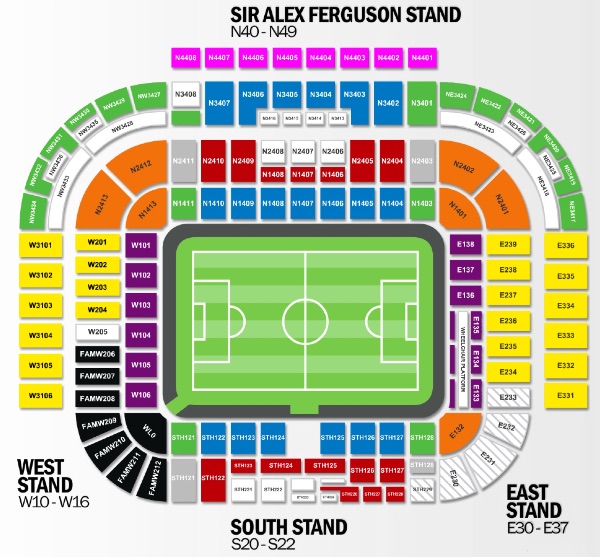
Old Trafford, nicknamed “The Theatre of Dreams” by Bobby Charlton, has been the home of Manchester United since 1910. As the largest club football stadium in the United Kingdom with a capacity of 74,879, it stands as an iconic venue in world football.
Historical Context and Stadium Overview
Key Historical Milestones
• Inauguration: Old Trafford was completed in late 1909 and hosted its first match on February 19, 1910, with Manchester United facing Liverpool (resulting in a 4-3 loss for United). A journalist at the time described it as “the most handsomest, the most spacious and the most remarkable arena I have ever seen.”
• World War II Impact: The stadium was bombed during the Second World War, forcing Manchester United to share Maine Road with Manchester City from 1941 to 1949.
• Expansions: Significant expansions in the 1990s and 2000s, including additional tiers to the North, West, and East Stands, increased the capacity to its current 74,879, close to its original 80,000.
• Centenary Celebration: In 2010, Old Trafford marked its 100th anniversary with a feature on Manchester United’s official website highlighting 100 memorable moments, with a top 10 selected by a panel including club statistician Cliff Butler and former players.
• Future Plans: In March 2025, Manchester United announced plans for a new 100,000-seater stadium, “New Trafford Stadium,” designed by Foster + Partners, to be built next to Old Trafford, with completion targeted for the 2030–31 season.
Stadium Features
• Capacity: 74,879, making it the largest club stadium in the UK and the 11th largest in Europe.
• Nickname: “The Theatre of Dreams,” coined by Bobby Charlton, reflecting its storied legacy.
• Accessibility: The club has partnered with AccessAble to provide detailed disability guides, offering British Sign Language tours and inclusive facilities.
• Non-Football Events: Old Trafford has hosted FA Cup finals, England internationals, the 1966 FIFA World Cup, UEFA Euro 1996, the 2012 Summer Olympics, UEFA Women’s Euro 2022, and the 2003 Champions League Final. It also hosts rugby league’s Super League Grand Final and Rugby League World Cup matches.
Directions to Old Trafford: Your Guide to Reaching the Theatre of Dreams
Old Trafford, the iconic home of Manchester United, is located in Manchester, England, and is easily accessible by various modes of transport. Whether you’re a local or a visitor, here’s a concise guide to help you get to the stadium for match day or a tour.
By Public Transport
Tram (Metrolink)
• Best Option: Take the Metrolink tram to Old Trafford station (Altrincham or Eccles lines). It’s a short 5-minute walk to the stadium.
• Directions: From Manchester Piccadilly or Victoria stations, board a tram towards Altrincham or Eccles via Salford Quays. Alight at Old Trafford station, then follow signs to the stadium.
• Tip: Trams run every 6-12 minutes. On match days, expect crowds—arrive early. Check Transport for Greater Manchester (TfGM) for live schedules.
• Accessibility: Old Trafford station has step-free access, but confirm with TfGM for specific needs.
Train
• Nearest Station: Manchester United Football Ground station (adjacent to the stadium).
• Directions: Catch a train from Manchester Piccadilly or Oxford Road to this station. Services are frequent on match days but limited otherwise.
• Note: Trains are less frequent than trams, so check National Rail for timetables.
• Accessibility: The station has limited step-free access—consider the tram for easier mobility.
Bus
• Routes: Bus 250, 255, or 256 from Manchester city center (Piccadilly Gardens) stop near Old Trafford on Wharfside Way or Chester Road.
• Directions: Journey takes about 15-20 minutes. Alight at Sir Matt Busby Way or Trafford Bar.
• Tip: Buses are busy on match days—plan for extra time. Use TfGM’s journey planner for real-time updates.
• Accessibility: Most buses are low-floor and wheelchair-friendly.
By Car
• Address: Old Trafford, Sir Matt Busby Way, Manchester, M16 0RA.
• Directions: From the M60, exit at Junction 7 (A56 Chester Road). Follow signs for Old Trafford. The stadium is well-signposted.
• Parking: Limited match-day parking is available at the stadium (pre-booking required via Manchester United’s website). Alternative car parks are at Salford Quays or Trafford Park.
• Tip: Arrive 2-3 hours early to secure parking. Avoid street parking due to restrictions.
• Accessibility: Disabled parking is available but must be pre-booked. Contact the club for details.
By Foot or Bike
• Walking: From Manchester city center (Deansgate), it’s a 40-minute walk (2.5 miles). Follow Deansgate south, then Chester Road to Sir Matt Busby Way.
• Cycling: Dedicated cycle routes connect the city center to Old Trafford. Secure bike parking is available near the stadium.
• Tip: Use Google Maps or TfGM’s cycle planner for the safest route.
• Accessibility: Pavements are generally wide and step-free, but check for match-day road closures.
By Air
• Nearest Airport: Manchester Airport (8 miles away).
• Directions: Take a taxi (20-30 minutes, £20-£30) or the Metrolink tram from the airport to Old Trafford station (change at Cornbrook, 40 minutes).
• Tip: Pre-book taxis for reliability. Check flight and tram schedules to align with match times.
Additional Notes
• Match Days: Roads around Old Trafford may close 2 hours before and after matches. Plan for delays.
• Stadium Tours: If visiting for a tour, public transport is recommended due to limited parking.
• Contact: For specific queries, visit Manchester United’s official website or contact TfGM.