Old Trafford: The Eternal Theatre of Dreams – A Manchester United Odyssey

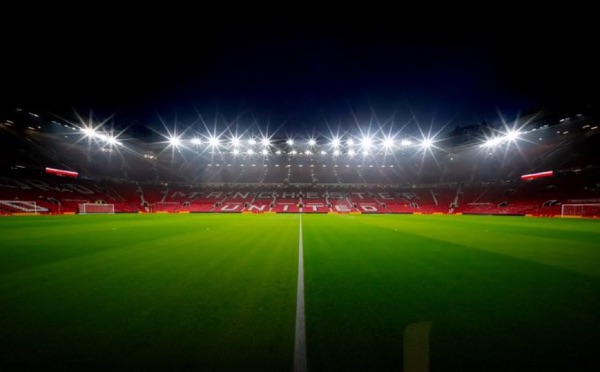
As a lifelong Red who’s bled United red since the days of watching grainy black-and-white replays of the Busby Babes on my grandad’s telly, there’s no place on earth that stirs the soul quite like Old Trafford. It’s not just a stadium; it’s the beating heart of Manchester United, a coliseum where legends are forged, tears are shed, and dreams – whether triumphant or heartbreaking – come alive. Nicknamed the “Theatre of Dreams” by the immortal Sir Bobby Charlton, our beloved home has stood tall in Trafford since 1910, witnessing every high and low of this great club’s storied journey. From the raw passion of the Stretford End to the echoes of Munich that still linger in the air, Old Trafford isn’t merely bricks and mortar – it’s family, it’s history, it’s us. And as we stand on the cusp of what could be its most transformative chapter yet, let’s dive deep into the epic tale of this iconic ground. Buckle up, Reds – this is going to be a proper ride through glory, grit, and unbreakable spirit.
The Birth of a Giant: From Bank Street to the Theatre of Dreams (1902–1910)
Picture this: It’s the early 1900s, and Manchester United – then still shaking off the Newton Heath tag – are slumming it at Bank Street in Clayton. The pitch is a quagmire, chemical fumes from nearby factories choke the air, and the facilities? Let’s just say they were dire. But salvation came in the form of one man: John Henry Davies, the chairman who saved the club from bankruptcy in 1902. Davies had ambition burning brighter than the Lancashire mills, and he dreamed big. He splashed out £60,000 (a fortune back then) on a plot of land adjacent to the Bridgewater Canal in Trafford Park – prime industrial real estate, but with space to grow.
Enter legendary architect Archibald Leitch, the Scot who designed so many of Britain’s classic grounds. Leitch’s blueprint was audacious: a bowl-shaped arena with one covered main stand (seating 3,000) and open terraces on the other three sides. Original plans called for 100,000 capacity, but costs forced a trim to around 77,000–80,000. On 19 February 1910, Old Trafford opened its gates for the first time. The inaugural match? A 4-3 defeat to bitter rivals Liverpool, of course – because even in birth, United loved a dramatic script. But oh, what a venue it was: vast, imposing, with red-brick facades that screamed permanence. From day one, it dwarfed anything else in English football. Crowds flocked – 70,504 packed in for a league game against Aston Villa in 1920, our pre-war record for a United match.
Those early years were electric. We won leagues in 1908 and 1911, the FA Cup in 1909, and Old Trafford quickly became the envy of the game. It hosted FA Cup finals (1911 replay, 1915 “Khaki Final” amid World War I), semi-finals, and even England internationals. The highest ever attendance? 76,962 for an FA Cup semi between Wolves and Grimsby in 1939 – a neutral game, but proof of the ground’s pulling power. Little did we know, darker days loomed.
Trials by Fire and Bomb: War, Destruction, and Rebirth (1939–1950s)
World War II changed everything. On 11 March 1941, during the Manchester Blitz, Luftwaffe bombs targeted Trafford Park’s factories – but Old Trafford took direct hits. The main stand was gutted, terraces cratered, pitch a wasteland. The ground was unrecognisable, reduced to rubble. For eight long years, we were homeless, ground-sharing with City at Maine Road (cheers, Blues – that £5,000 annual rent plus gate shares stung, but rivalry paused for survival).
Rebuilding started post-war, funded partly by a £22,000 War Damage Commission payout. By 1949, we were back – a poignant 2-1 win over Bolton on 24 August marked the return. Capacity hovered around 60,000–70,000 in the 1950s, with floodlights added in 1957 and roofs extended. But the true rebirth came under Sir Matt Busby. His Babes – Duncan Edwards, Roger Byrne, Tommy Taylor, and a young Bobby Charlton – lit up the rebuilt Theatre. League titles in 1952, 1956, and 1957; that thrilling European Cup run… Old Trafford roared again.
Then came the unimaginable tragedy.
Munich: The Day the Dreams Shattered (1958)
No United fan can speak of Old Trafford without feeling that chill. On 6 February 1958, after a 3-3 draw in Belgrade against Red Star (securing our European Cup semi spot), the team plane stopped in Munich for refuelling. Slush on the runway, two failed take-offs… on the third, disaster. The plane crashed, killing 23 – including eight Busby Babes: Geoff Bent, Roger Byrne, Eddie Colman, Mark Jones, David Pegg, Tommy Taylor, Liam Whelan, and Billy Whelan (wait, no – the immortals: Byrne (captain), Colman, Jones, Pegg, Taylor, Whelan, Bent, and the irreplaceable Duncan Edwards, who fought for 15 days before succumbing.
Journalists, staff, and others perished too. Sir Matt clung to life; Bobby Charlton and Dennis Viollet survived. Old Trafford fell silent. The clock on the East Stand froze forever at 3:04pm – the exact time of the crash. A plaque, the Munich Tunnel, memorials – they remind us every matchday. Yet from ashes rose phoenix: Jimmy Murphy took charge, we reached the 1958 FA Cup final (lost to Bolton), and inspired by Munich’s spirit, Busby rebuilt. Charlton, Best, Law – the Holy Trinity – would conquer Europe in 1968, beating Benfica 4-1 at Wembley (Old Trafford hosted semis). Munich broke us, but it made us unbreakable. It’s why we sing “Flowers of Manchester” – eternal respect.
The Glory Years and Gradual Evolution (1960s–1980s)
The 1960s saw the North Stand renovated – private boxes arrived, a first in Britain. Capacity dipped and rose around 60,000. We won the league in 1965 and 1967, that European Cup in ‘68 – Old Trafford hosted group games for the 1966 World Cup (Portugal’s Eusebio dazzled). The Stretford End became legendary: bouncing, singing, intimidating. George Best jigging past defenders, Denis Law’s backheels – pure magic.
The 1970s and 80s brought roofs over terraces, better facilities, but also hooliganism fences (dark times). Capacity stabilised around 56,000–60,000. We yo-yoed a bit post-Busby, but Big Ron Atkinson and then Sir Alex Ferguson in 1986 ignited the fire. Fergie’s early years were tough, but Old Trafford’s atmosphere? Unmatched. The 1990 FA Cup win (beating Palace) saved him – and sparked the dynasty.
The Ferguson Revolution and Modern Expansions (1990s–2000s)
Enter the 1990s: Hillsborough’s Taylor Report mandated all-seaters by 1994. Terraces gone, capacity plummeted to ~44,000 – our lowest ever. But success demanded growth. The 1995 North Stand rebuild – a massive three-tier beast holding 25,500, with Europe’s largest cantilever roof – hosted Euro 96 games (including a semi). Capacity jumped to 55,000+.
Then the masterstroke: Under Fergie, we dominated. Second tiers on East and West Stands (2000–01) pushed to 68,000. Quadrant corners in 2006 added 8,000 more, hitting 76,212 – largest club ground in Britain. Record all-seater attendance: 76,098 vs Blackburn, 31 March 2007 (4-1 win, Giggsy scoring). We hosted the 2003 Champions League final (Milan vs Juventus, 0-0), Rugby League Grand Finals, Olympics football in 2012.
Old Trafford became a fortress: Treble ‘99 vibes, that epic 2008 CL semi vs Barcelona, Rooney’s overhead vs City, Scholes’ volley vs Villa. Fergie’s North Stand rename in 2011, South Stand after Sir Bobby in 2016. Capacity tweaked to ~74,140 today (74,244 as of 2025 adjustments for accessibility).
Capacity Evolution Line Chart (Approximate Historical Data):
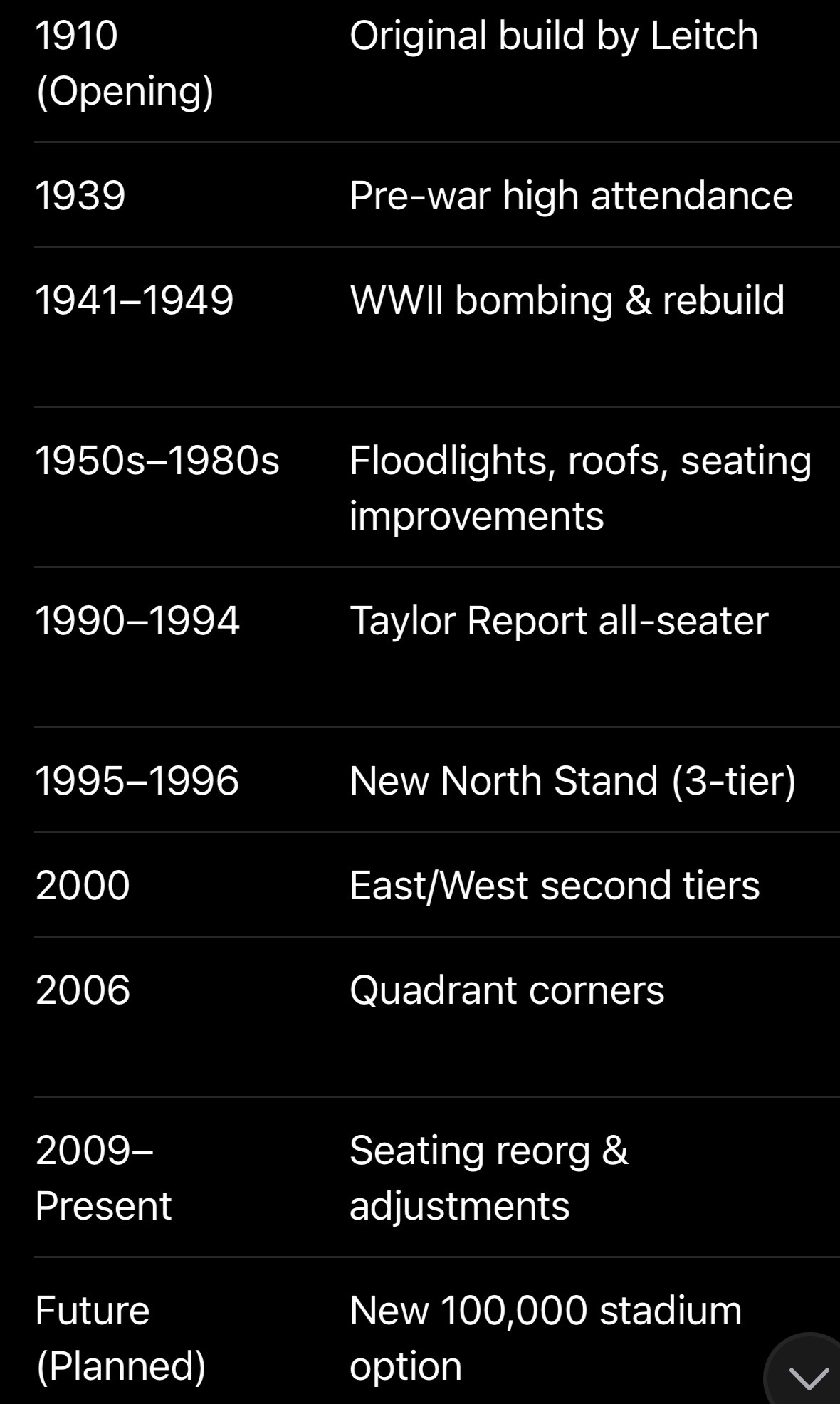
Analytically, expansions correlated perfectly with on-pitch glory: No titles pre-1995 rebuild? Limited growth. Treble ’99? Boom. 13 PL titles under Fergie? Old Trafford grew into a 76k monster, generating revenue for stars like Cantona, Beckham, Ronaldo (the real one), Rooney.
The Modern Era: Challenges and the Dawn of Regeneration (2010–2025)
Post-Fergie retirement in 2013, we’ve had ups (Europa ’17, FA Cup ‘16) but pains. Old Trafford aged: Leaks, rust, rats even reported. No major work since 2006 quadrants. Capacity tweaks for safety/accessibility, but it’s the largest club ground still.
Yet hope surges! Sir Jim Ratcliffe’s 2024 investment sparked the Old Trafford Regeneration Task Force (led by Lord Coe). Options: Renovate to ~87,000 or build a brand-new 100,000-seater adjacent (on current land, allowing play during construction). In March 2025, United confirmed the new-build preference – a £2bn+ masterpiece by Foster + Partners, with a vast canopy, trident masts, “Wembley of the North.” Government backing (Chancellor Reeves championing), potentially £7.3bn economic boost, 90,000+ jobs. It’ll regenerate Trafford Wharfside – homes, business, transport.
Fair critique: Renovation would’ve preserved history cheaper, but a new 100k arena? World-class, future-proof, affordable (we hope – STs demand no pricing out fans). Enthusiastically? This is Ratcliffe delivering. Imagine 100,000 roaring for a new generation – Hojlund, Mainoo, Garnacho under Amorim. Old Trafford’s spirit lives on, evolved.
Why Old Trafford is Eternal
From 1910’s opener to potential 2030 handover, Old Trafford has seen 20 titles, 12 FA Cups, 3 European Cups, Munich’s sorrow, Best’s genius, Fergie’s hairdryer, that ‘99 night. It’s hosted World Cups, Euros, Olympics, rugby. The Munich clock ticks no more, but the dreams? Endless.
As a Red for life, I’m emotional: The old girl deserves this glow-up. She gave us everything – now we give her the future. Glory Glory Man United – and long live the Theatre of Dreams!