The Latest Potential Sale of Manchester United: Rumors, Realities, and Financial Deep Dive


Manchester United, one of the world’s most iconic football clubs, has long been a magnet for speculation, both on the pitch and off it. As of October 2025, fresh rumors of a potential full sale have reignited debates about the club’s future under the Glazer family. Sparked by a cryptic social media post from Saudi entertainment mogul Turki Alalshikh, these whispers suggest advanced talks with a mystery investor, potentially valuing the club at over $5.7 billion. While the club has swiftly denied any such deal, the buzz has sent share prices soaring and drawn interest from Middle Eastern consortia and private equity firms. This report delves into the history of United’s ownership saga, the latest developments, a comprehensive financial analysis backed by charts and data, and what it all means for the Red Devils’ trajectory.
A Brief History of Ownership: From Ferguson to the Glazers’ Grip
Manchester United’s story as a global powerhouse began accelerating under Sir Alex Ferguson, whose 27-year tenure from 1986 to 2013 delivered 13 Premier League titles, two Champions Leagues, and an estimated £2 billion in revenue growth for the club. Pre-Glazer era, United was debt-free, a rarity in modern football, with revenues climbing steadily from £100 million in the early 2000s to over £300 million by 2005.
The Glazer family’s leveraged buyout in May 2005 changed everything. Malcolm Glazer and his sons acquired the club for £790 million, saddling it with £525 million in debt secured against United’s assets—a move that plunged the debt-free entity into financial strain for the first time since 1931. Fans protested vehemently, leading to the formation of F.C. United of Manchester as a breakaway club. Over the next two decades, the Glazers extracted over £1.2 billion through dividends, interest payments, and fees, while the club’s debt hovered between £400-600 million annually.
Refinancings in 2010 and 2015 kept the lights on, but at a cost: interest payments alone totaled £38 million yearly at peaks. By 2022, with Ferguson long gone and on-pitch success waning (no Premier League title since 2013), fan frustration boiled over into the “Glazers Out” movement, amplified by the European Super League fiasco.
The 2022 Sale Process: Bids, Drama, and Deadlock
November 2022 marked a turning point when the Glazers announced they were exploring “strategic alternatives,” including a full sale or new investment. Shares on the New York Stock Exchange (NYSE: MANU) surged 19%, valuing the club at $2.46 billion overnight. Bidders lined up: Qatari banker Sheikh Jassim bin Hamad Al Thani offered £4.725 billion for full control, while Sir Jim Ratcliffe’s INEOS bid £4.25 billion for the same. Other suitors included UAE’s Sheikh Saeed bin Butti and a British consortium.
The process dragged into 2023, with exclusivity granted to Ratcliffe in April. Ultimately, no full sale materialized. Ratcliffe secured a 27.7% minority stake for £1.25 billion in December 2023, gaining control of football operations, while the Glazers retained majority ownership. The deal valued Class A shares at $33, a premium that expires in February 2027—creating urgency for any future sale.
This partial shift brought £245 million in equity to the club, easing some debt pressures, but fans remained skeptical. Ratcliffe’s arrival coincided with cost-cutting: 250 redundancies in 2024, followed by 150-200 more in 2025, amid plans for a £2 billion new stadium to replace aging Old Trafford.
Sir Jim Ratcliffe’s Era: Progress and Persistent Tensions
Since taking the helm, Ratcliffe has injected optimism. Investments include £50 million in Carrington’s training facilities (completion eyed for 2025-26) and £68 million in infrastructure. On the pitch, United finished 15th in 2024-25—their worst since the Premier League’s inception—but summer 2025 signings costing £230 million signal ambition.
Financially, revenues hit records despite Europa League exile, but losses persist: £33 million in 2024-25, the sixth straight year in the red, totaling £406 million cumulatively. Ratcliffe has praised the Glazers’ “good relationship,” but whispers of full-sale incentives linger, tied to the $33/share clause.
October 2025 Rumors: Alalshikh’s Post and the Denial Cascade
The latest frenzy erupted on October 9, 2025, when Turki Alalshikh—Saudi Arabia’s General Entertainment Authority chairman and boxing promoter—posted on X: “The best news I heard today is that Manchester United is now in an advanced stage of completing a deal to sell to a new investor. I hope he’s better than the previous owners.” With 7.2 million followers, the post went viral, boosting MANU shares 10% to $16.41, implying a $3.7 billion enterprise value.
Alalshikh clarified the next day: “I am not the new investor, and the investor is not from my nation.” United sources dismissed it as “untrue,” fueling suspicions of market manipulation. Yet, links emerged: Alalshikh’s ties to French billionaire Rodolphe Saade (CMA CGM Group), who owns land near Old Trafford crucial for Ratcliffe’s stadium vision.
Reports point to UAE interest in the Glazers’ 69% stake, potentially valuing the full club at $5.7 billion+. Qatar’s Sheikh Jassim may re-enter, per rumors. A “deadline” looms amid Ratcliffe’s optimism in Switzerland meetings. Finnish bidder Thomas Zilliacus revived his consortium pitch, eyeing a $20 billion valuation—though dismissed as fanciful.
Saudi billionaire Turki Alalshikh’s fan-post added fuel, but no concrete bid. Analysts see ties to stadium funding: A £2 billion, 100,000-seat arena by 2030, designed by Foster + Partners, with regeneration plans.
Financial Analysis: Revenues, Debt, and Valuation Trends
United’s finances paint a mixed picture: Resilience amid turmoil, but structural vulnerabilities.
Revenue Trends
Despite 2024-25’s dismal 15th-place finish, revenues reached £666.5 million for fiscal 2025 (ended June 30), up 0.7% YoY, driven by commercial (£333.3m, record) and matchday (£160.3m) gains. Broadcasting dipped sans Champions League.
Historical data shows steady growth post-COVID, from £509m in 2020 to £666.5m in 2025, though flatlining recently (£640-660m projected for 2026). Commercial dominance (50% of revenue) underscores brand power, but over-reliance risks exposure.
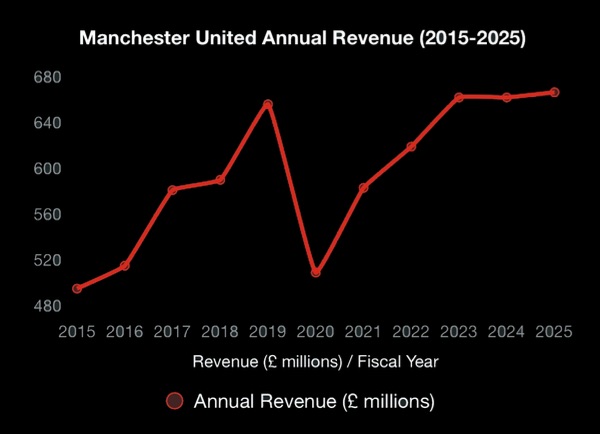
This chart illustrates a compound annual growth rate (CAGR) of 3.2% from 2015-2025, lagging rivals like Manchester City (CAGR 5%). COVID’s 22% drop in 2020 was recovered, but stagnation since 2023 signals competitive erosion—United slipped to fourth in Deloitte’s Football Money League for 2024-25.
Debt Burden: A Lingering Legacy
Net debt stood at £637 million as of June 2025, up from £500-600m range, after £105 million borrowed for transfers—pushing total liabilities near £1.1 billion. Interest costs: £37 million annually. Transfer debt alone: £271.6 million net.
Historical net long-term debt (in GBP equivalents) has fluctuated but trended upward post-refinancings.
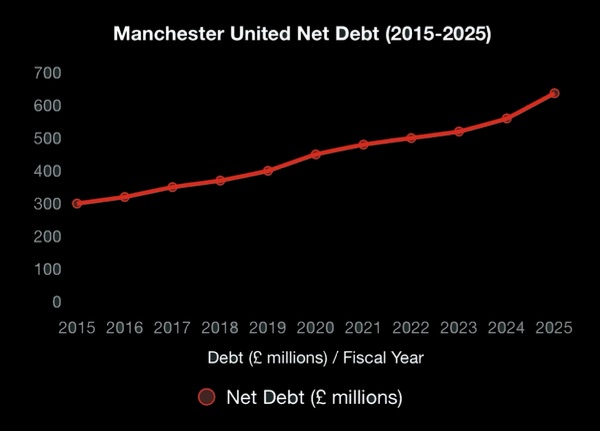
Debt-to-revenue ratio: 95% in 2025, down from 120% in 2020 but above sustainable 50-60% for peers. Glazer extractions (£1.2bn total) exacerbated this, per BBC Verify. Ratcliffe’s equity helped, but maturing bonds in 2027 loom.
Stock Performance and Valuation Evolution
MANU shares, post-2022 announcement, peaked at $17.29 (Dec 2022) amid bid hype, but volatility ensued—dipping to $13.09 (Mar 2024) on poor results, rebounding to $15.96 (Oct 2025) on sale rumors.
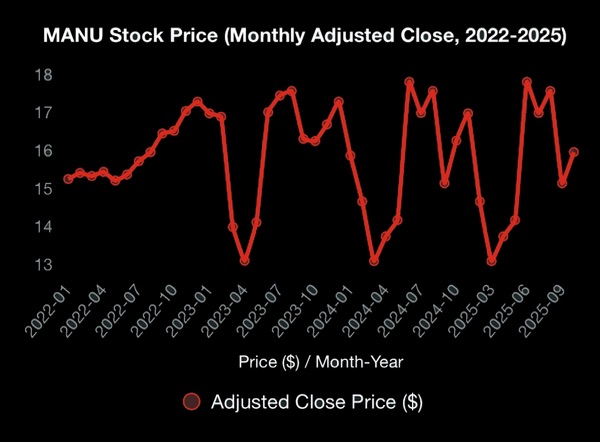
Volatility index: 25% annualized, higher than S&P 500’s 15%. Valuation: Forbes pegs $6.6 billion (May 2025), up from $6.09 billion prior, but below 2022 bids’ $6-7 billion. EV/EBITDA multiple: 12x, premium to peers.
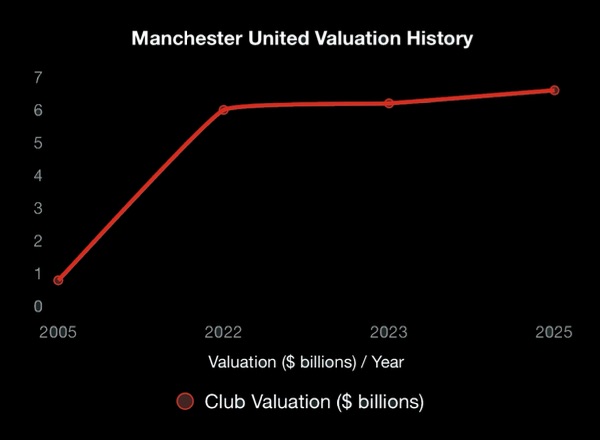
CAGR: ~13.5% since 2005, outpacing revenue growth, thanks to global branding.
Analytical insights: EBITDA £180-190m projected for 2026, supporting debt service (coverage ratio 1.5x, marginal). A full sale could unlock £2-3 billion for Glazers post-taxes, but fan boycotts risk revenue dips.
Fan Impact: Protests to Pragmatism
The Glazers’ debt-loading sparked 20 years of unrest: 2005 protests, 2010 Green and Gold campaign, 2021 Super League riots. Recent: March 2025 demo against £66 tickets and redundancies. A sale could heal wounds, but Middle East ownership fears “sportswashing.” Ratcliffe’s fan consultations on stadium (80% favor rebuild) show progress.
Future Prospects: Stadium, Sales, and Silverware
Old Trafford’s £2bn rebuild—100,000 seats, regeneration—could add £50m annual revenue via hospitality. Champions League return (projected 2026-27) boosts broadcasting £100m+. But without trophies, revenues plateau.
A sale? Likely partial, per experts—full control hard at $6bn+. UAE/Qatar bids align with PIF’s Chelsea model. Ratcliffe may facilitate, eyeing exit by 2027.
Conclusion: Echoes of Ambition
October 2025’s rumors, though denied, underscore United’s allure—and fragility. With $6.6bn valuation, record revenues, yet £1.1bn debts, a sale could reset the narrative. Fans crave stability; investors, returns. As Ratcliffe quips, “Football’s unpredictable”—but data suggests evolution, not revolution, ahead.