The Legendary Defensive Partnership: Nemanja Vidic and Rio Ferdinand at Manchester United

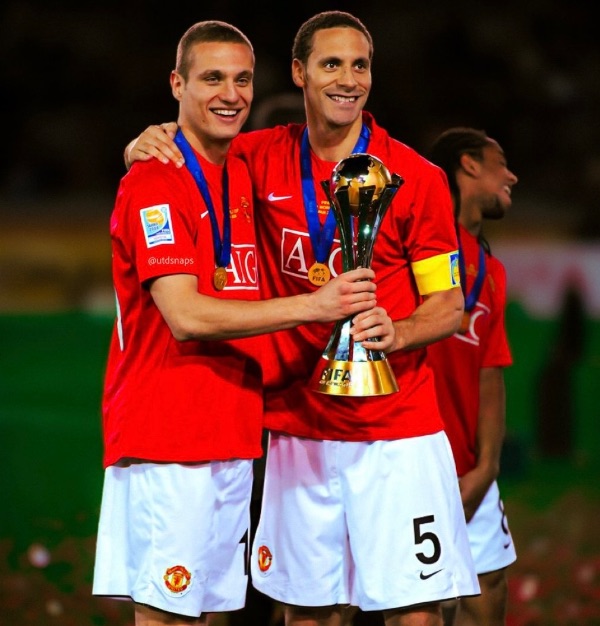
In the annals of Premier League history, few defensive duos have left as indelible a mark as Nemanja Vidic and Rio Ferdinand. Their partnership at Manchester United, spanning from 2006 to 2014, was the bedrock of Sir Alex Ferguson’s final era of dominance. Together, they anchored a backline that conceded the fewest goals in the league during key seasons, won multiple titles, and struck fear into opposing attackers. Vidic, the relentless Serbian warrior, and Ferdinand, the elegant English ball-player, complemented each other perfectly, forming what many consider the greatest centre-back pairing in English football. This article delves deep into their story, from humble beginnings to triumphant peaks, backed by analytical data, key moments, and visual representations of their defensive prowess.
The Origins: How Two Defenders Became United’s Backbone
Rio Ferdinand arrived at Manchester United in July 2002 from Leeds United for a then-British record fee of £30 million. At 23, he was already a proven talent, having helped Leeds reach the Champions League semi-finals. Ferdinand’s style was modern for the era: composed on the ball, excellent in reading the game, and capable of initiating attacks from deep. He quickly became a staple in Ferguson’s defense, partnering with various players like Mikael Silvestre and Wes Brown. However, it wasn’t until January 2006 that his ideal complement arrived.
Nemanja Vidic joined from Spartak Moscow for £7 million, a relative unknown in Western Europe despite his success in Russia and Serbia. Born in Titovo Uzice, Yugoslavia (now Serbia), Vidic rose through the ranks at Red Star Belgrade, where he won the domestic double in 2004. His move to Spartak made him the most expensive defender in Russian league history at the time, but adapting to the Premier League was no small feat. Vidic’s early days at United were challenging; he struggled with the pace and physicality, even admitting in later interviews that he considered leaving after a tough debut period. Ferdinand, already established, played a mentoring role, helping Vidic settle.
Their first joint appearance came in a 4-3 win over Bolton Wanderers in March 2006, but it was the 2006-07 season where the partnership truly began to gel. United won the Premier League that year, their first in four seasons, with Vidic and Ferdinand starting together in 24 league games. The duo’s synergy was evident: Ferdinand’s anticipation paired with Vidic’s aerial dominance and tackling created a formidable barrier. By season’s end, United conceded just 27 goals in the league, a marked improvement.
Expanding on their individual paths, Ferdinand’s journey started at West Ham, where he broke through as a teenager, earning a move to Leeds in 2000. His £18 million transfer to Leeds was a record for a defender, and his performances there, including captaining the side, caught Ferguson’s eye. Vidic, meanwhile, grew up in a war-torn region, honing his toughness through youth academies. His nickname “Vidic the Beast” stemmed from his uncompromising style, which contrasted Ferdinand’s “Rolls Royce” elegance—a moniker given by fans for his smooth defending.
This contrast was no accident; Ferguson deliberately sought a partner for Ferdinand who could handle the dirty work. In his autobiography, Ferguson noted Vidic’s “warrior spirit” as key to balancing the defense. Over their eight years together, they started 187 games across all competitions, winning 123 (65.8% win rate), drawing 35, and losing only 29. These numbers underscore their reliability, but the real story lies in the trophies: five Premier League titles (2007, 2008, 2009, 2011, 2013), three League Cups (2006, 2009, 2010), one Champions League (2008), and one Club World Cup (2008).
The Peak: Dominance in 2007-2009
The 2007-08 season was the pinnacle. Vidic and Ferdinand started 41 games together across all competitions, more than any other pair that year. United’s defense was impenetrable, conceding just 22 goals in the Premier League—the fewest in the league’s history at that point for a 38-game season. In Europe, they were equally stellar, helping United reach the Champions League final against Chelsea in Moscow.
That final on May 21, 2008, epitomized their partnership. Amid pouring rain, Vidic’s headers and blocks neutralized Didier Drogba, while Ferdinand’s interceptions thwarted Frank Lampard. The game ended 1-1, with United winning on penalties. Vidic later reflected on the moment: “It was the highlight of my career.” Ferdinand echoed this, calling it “the ultimate test.” Their combined efforts yielded 25 clean sheets that season.
The following year, 2008-09, saw even more records. United set a Premier League record with 14 consecutive clean sheets from November 2008 to February 2009, a streak where Vidic and Ferdinand were ever-present. Overall, they achieved 24 clean sheets in the league, conceding only 24 goals. United retained the title, making it three in a row, and reached another Champions League final (losing to Barcelona). Between 2007 and 2009, in 75 games together, they kept 45 clean sheets and conceded just 0.53 goals per game—a statistic that highlights their lockdown ability.
Injuries occasionally disrupted them, but their resilience shone. Vidic missed parts of 2009-10 due to a calf issue, yet United still won the League Cup. Ferdinand’s back problems in 2010-11 limited him, but Vidic captained the side to another title. Their ability to perform under pressure was unmatched; in high-stakes derbies against Manchester City and Liverpool, they often delivered masterclasses.
Analytical Data: Breaking Down the Numbers
To truly appreciate Vidic and Ferdinand’s impact, let’s examine the data. From 2006-07 to 2013-14, Manchester United’s defensive metrics improved dramatically with them at the heart.
In the Premier League:
• 2006-07: 27 goals conceded, 17 clean sheets
• 2007-08: 22 goals conceded, 21 clean sheets
• 2008-09: 24 goals conceded, 24 clean sheets
• 2009-10: 28 goals conceded, 16 clean sheets (Vidic injured for spells)
• 2010-11: 37 goals conceded, 15 clean sheets (Ferdinand injuries)
• 2011-12: 33 goals conceded, 17 clean sheets
• 2012-13: 43 goals conceded, 11 clean sheets
• 2013-14: 43 goals conceded, 13 clean sheets (end of era)
The trend shows their prime years (2007-09) as the stingiest, with an average of 0.63 goals conceded per game. Vidic individually kept 95 clean sheets in 211 Premier League appearances, with a 70.6% win rate. Ferdinand had 189 clean sheets in his career, but during their partnership, his passing accuracy (often over 85%) complemented Vidic’s 11.7 clearances per 90 minutes.
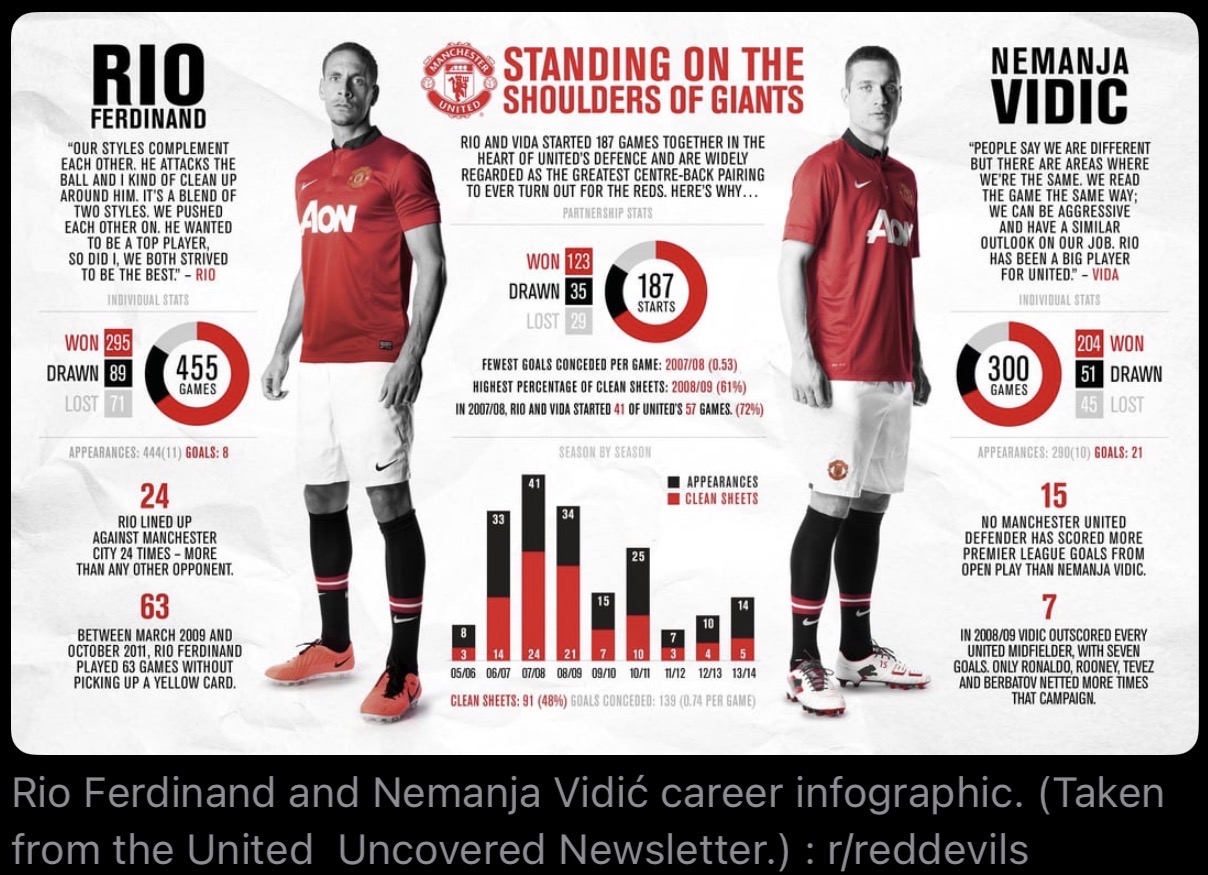
This infographic illustrates their seasonal clean sheets and appearances. Note the peak in 2007-08 and 2008-09, where clean sheets (red bars) consistently outnumbered goals conceded. In 2007-08, they achieved 21 clean sheets in 34 starts together, a 61.8% rate. Analytically, their highest percentage of clean sheets came in 2008-09 at 71% when paired.
Comparing to other duos, like Steve Bruce and Gary Pallister (United’s 1990s pair), Vidic-Ferdinand edged them in clean sheets per game (1.99 vs. 2.38 games per clean sheet). Against modern pairs like John Terry and Ricardo Carvalho at Chelsea, who conceded 15 goals in 2004-05, Vidic-Ferdinand’s multi-season consistency stands out—they maintained sub-30 goals conceded for four straight years.
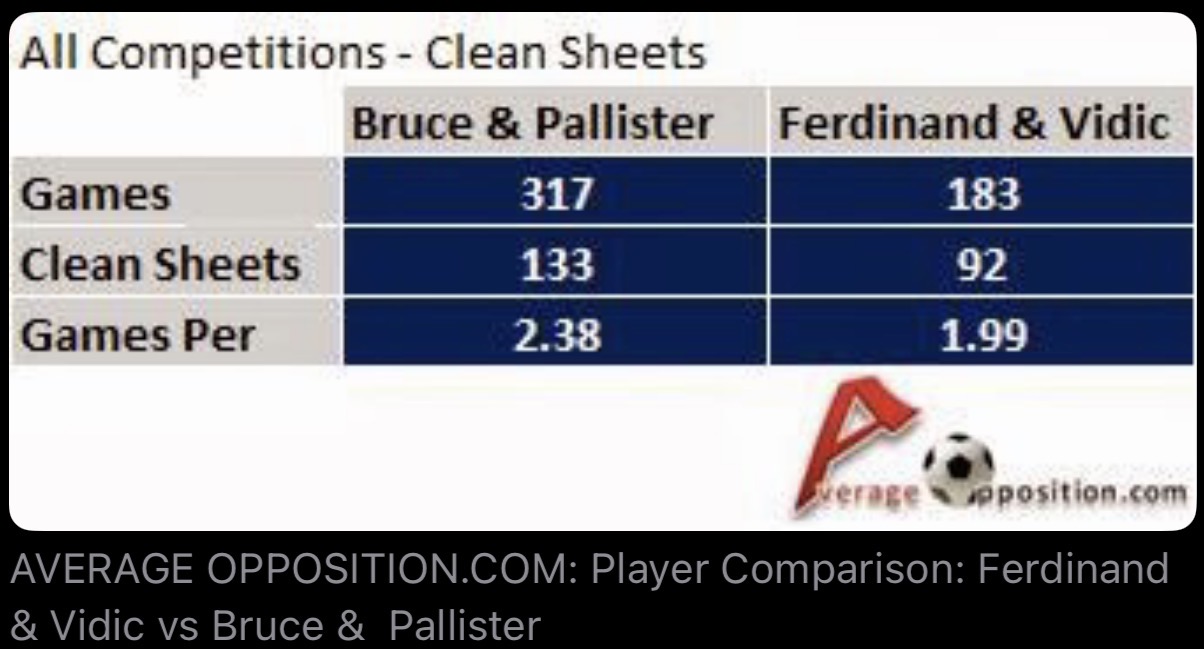
Here, the table shows Vidic-Ferdinand with 92 clean sheets in 183 games (all comps), better than Bruce-Pallister’s 133 in 317. Per-game efficiency favored the modern duo, reflecting the evolving game.
Vidic’s individual stats: 363 tackles, 2,232 clearances, and only 3 errors leading to goals in 211 games. Ferdinand added 292 tackles but excelled in interceptions (higher than Vidic’s 2.05 per 90). Together, their duel win rate hovered around 65-70%, making them dominant in aerial and ground battles.
In Champions League play, they conceded 0.72 goals per game in 50 joint starts, with 22 clean sheets. Data from Opta and Transfermarkt confirms their era as United’s most defensively sound.
Key Matches and Iconic Moments
Their legacy is etched in pivotal games. The 2008 Champions League final stands out, but let’s revisit others.
• Manchester United 1-0 Barcelona (2008 UCL Semi-Final, Second Leg): After a 0-0 first leg, Paul Scholes’ goal won it, but Vidic and Ferdinand’s defending against Lionel Messi and Samuel Eto’o was heroic. Vidic made 12 clearances; Ferdinand intercepted 5 times. Messi later called them “the toughest pair I faced early on.”
• Liverpool 1-4 Manchester United (2009 Premier League): Down 1-0 at Anfield, United roared back. Vidic scored the equalizer, but his red card couldn’t stop a 4-1 win. Ferdinand’s calm distribution set up attacks, showcasing their influence beyond defending.
• Manchester United 2-1 Chelsea (2011 Premier League): A title-deciding clash. Vidic scored the opener, and their duo shut out Drogba, conceding once late. United won the league by nine points.
• The 14-Game Clean Sheet Streak (2008-09): From a 3-0 win over Chelsea to a 0-0 with Arsenal, including shutouts against Inter Milan in the UCL. Edwin van der Sar in goal benefited immensely, but Vidic-Ferdinand’s organization was key.
Vidic’s goals added flair—21 in total for United, including headers against Liverpool and Wigan that clinched titles. Ferdinand’s rare strikes, like against Swansea in 2013, marked emotional farewells.
In derbies, they owned Manchester City; in a 2009 4-3 thriller, their blocks preserved the win. Against Arsenal’s “Invincibles” remnants, they neutralized Henry, with Ferdinand once saying, “Vidic would die to stop a goal.”
Complementary Styles: The Tank and the Rolls Royce
The magic lay in their differences. Vidic was the aggressor—nicknamed “an animal” by Ferdinand—winning 6.73 duels per 90, with ferocious tackles. He led the league in clearances multiple times, embodying the “no-nonsense” defender. Ferdinand, conversely, was the thinker: 83.4% passing accuracy, fewer fouls, and positional awareness that prevented dangers early.
Ferguson praised this in interviews: “Rio reads the game; Vida fights it.” Their communication was telepathic; Vidic noted, “We see the game the same way.” This balance allowed full-backs like Patrice Evra and Gary Neville to bomb forward, contributing to United’s attacking flair with Ronaldo, Rooney, and Tevez.
Off the pitch, their bond strengthened the team. Ferdinand hosted barbecues; Vidic, more reserved, led by example. This unity filtered through the squad, fostering a winning mentality.
Challenges: Injuries and the Twilight Years
No partnership is without hurdles. Ferdinand’s 2003 drug test ban sidelined him for eight months, but post-Vidic, injuries mounted. Ferdinand’s chronic back issues from 2009 limited him to 19 league games in 2010-11. Vidic suffered a cruciate ligament tear in 2011, missing half the season, and another injury in 2013-14.
These absences coincided with United’s defensive dips—37 goals conceded in 2010-11, 43 in 2012-13. Yet, they adapted; younger players like Jonny Evans filled in, but the duo’s return always stabilized. Vidic left for Inter Milan in 2014, Ferdinand for QPR, marking the end. Post-Ferguson, United’s defense has never replicated that solidity, conceding over 50 goals in recent seasons.
Legacy and Comparisons
Vidic and Ferdinand’s influence endures. Vidic is one of four players to win the Premier League Player of the Season twice (2009, 2011). Ferdinand made the PFA Team of the Year six times. Their partnership is often compared to Terry-Carvalho (Chelsea’s 2004-07 duo, 54% clean sheets) or Virgil van Dijk and partners at Liverpool.
Statistically, Vidic edges van Dijk in tackles (1.55 vs. 0.88 per 90) and clearances (11.7 vs. 6.11), though van Dijk excels in passing (87.8% vs. Vidic’s 83.4%). Ferdinand rivals van Dijk in composure.
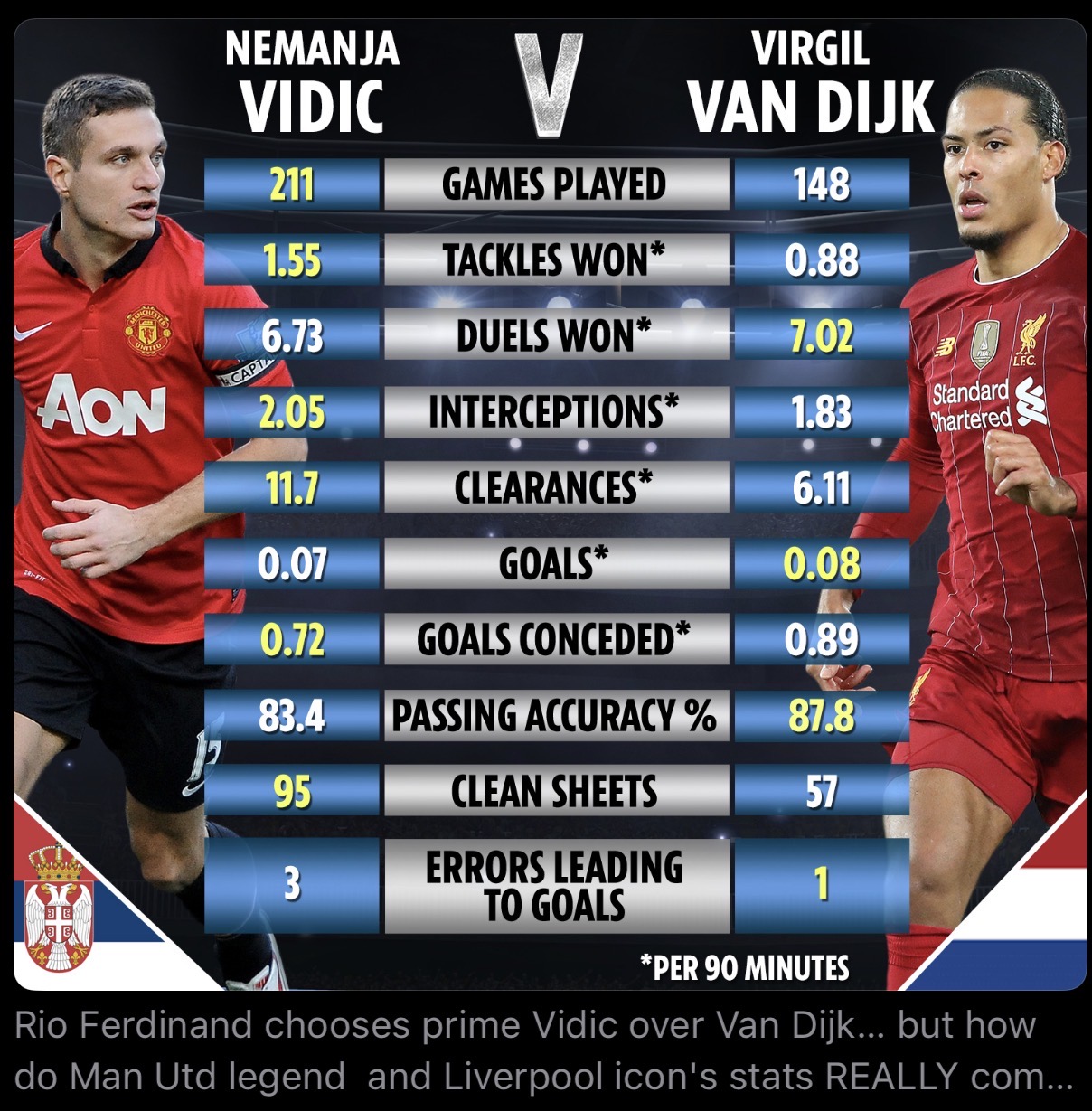
This chart shows Vidic’s edge in defensive actions, with 95 clean sheets vs. van Dijk’s 57 (as of 2020 data). However, contexts differ—United’s team was more attacking.
Their legacy inspires modern defenders; Harry Maguire cited them as idols upon joining United. Fans on platforms like X (formerly Twitter) still debate their supremacy, with videos of their highlights garnering thousands of views.
In retirement, Ferdinand hosts “Vibe with Five,” often reminiscing with Vidic. Vidic coaches in Serbia, passing on lessons. Their nine major honors together cement them as icons.
Conclusion: An Unbreakable Bond
Nemanja Vidic and Rio Ferdinand’s partnership wasn’t just about stats or trophies—it was about trust, balance, and excellence. They turned United’s defense into a fortress, enabling attacking brilliance. In an era of fluid football, their solidity remains a benchmark. As Ferdinand said, “We pushed each other to be the best.” For Manchester United fans, they embody glory; for football purists, they define defensive mastery.