88 Years of Red Blood: Manchester United’s Unrivalled Academy Tradition Lives On

Since 30 October 1937 – the day we lost 1-0 at Fulham with not a single homegrown lad on the teamsheet – every single Manchester United matchday squad, in every competition, through war, through peace, through Munich, through glory, through the dark days and the golden ones, has contained at least one player who came through our academy. That is 4,333 consecutive games (and counting) as of today. No other club on the planet comes close.
This isn’t just a statistic. It’s the soul of Manchester United.
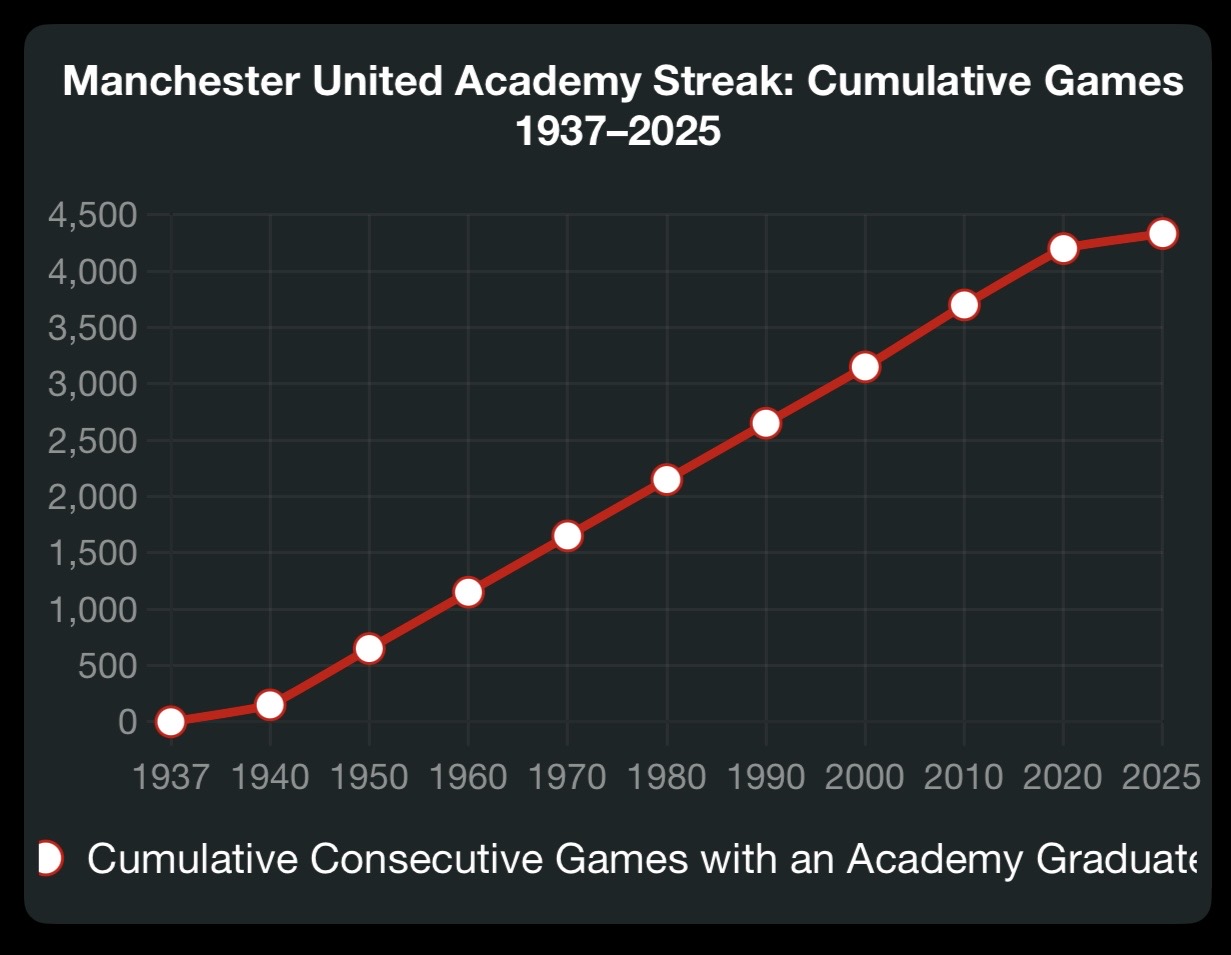
Look at that line. It never dips. It never falters. It just climbs relentlessly, decade after decade. Even when bombs were falling on Manchester, even when the club had to be rebuilt from ashes after Munich, even when we were relegation fodder in the 1970s, even when the Glazers sucked the joy out of the place – the academy kept giving us one of our own.
The Origins – The 1930s and the Birth of a Philosophy
The streak officially began on 6 November 1937 when Stan Pearson and three other youngsters were named for the visit of Manchester City. But the real architect was Matt Busby, who arrived in 1945 with a vision: build a team around youth, not chequebooks.
Busby, Walter Crickmer, and Jimmy Murphy scoured the country for raw talent. They didn’t care about reputation; they cared about heart, hunger, and red blood. By the mid-1950s the Babes were averaging eight or nine academy lads in every squad. Eight or nine! In today’s money that would be unthinkable.
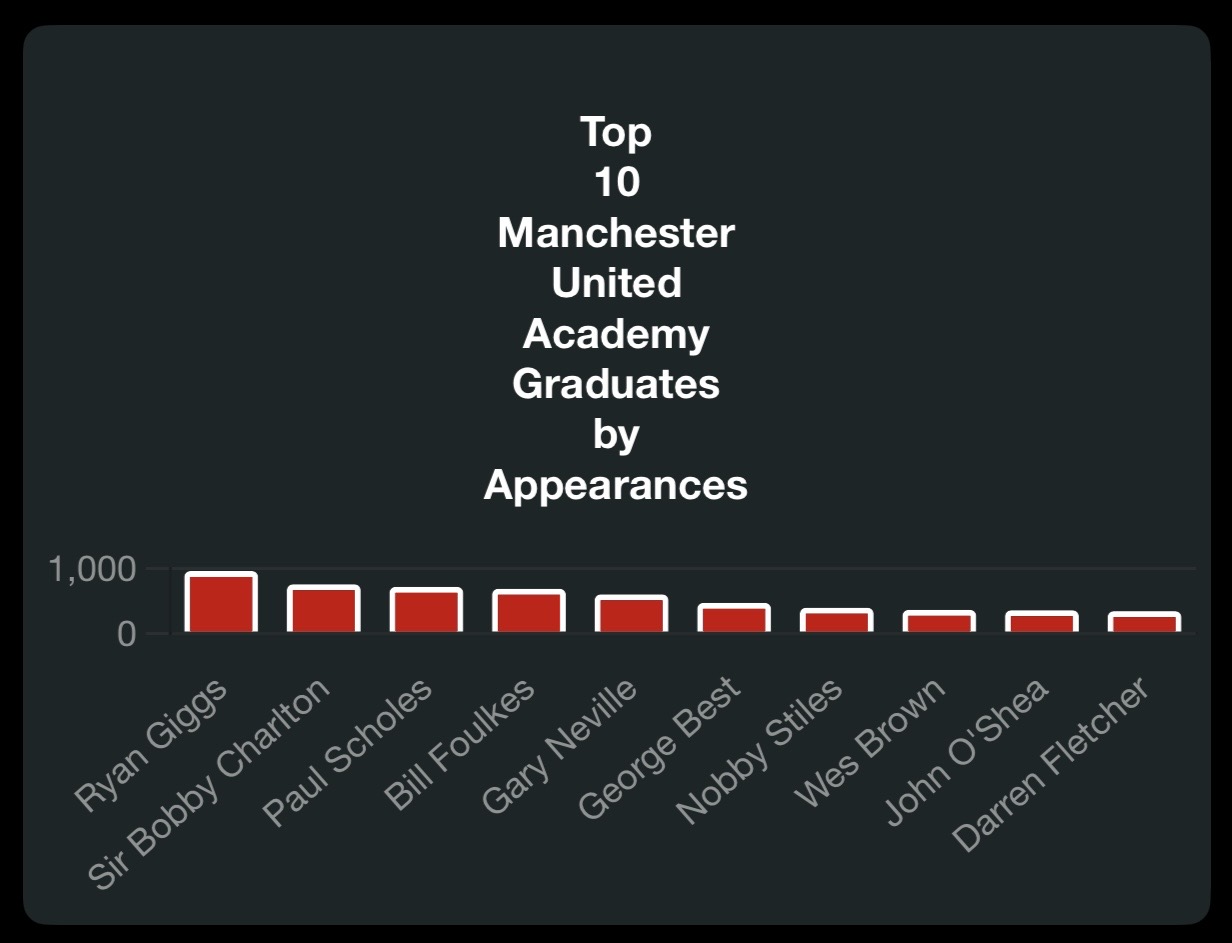
Ryan Giggs sits alone at the top with 963 appearances – a number that will never be beaten. But look at the names behind him: Charlton surviving Munich to become a European Cup winner, Scholes the ginger genius, Foulkes the rock at the back, Neville the captain courageous. These aren’t just players. They are the DNA of our football club.
The Munich Shadow and the Rebuild
6 February 1958. Eight Busby Babes died. The average age of the team that played Charlton Town three days later was 22. Jimmy Murphy took temporary charge and refused to buy his way out of grief. He promoted kids. Bobby Charlton, Shay Brennan, Alex Dawson – teenagers thrown into the abyss – kept the streak alive and kept the club alive.
In the 1958-59 season the average number of academy players in the squad was still over seven. That’s not just remarkable; it’s heroic.
The Famine Years – 1970s and Early 1980s
The 1970s were grim. Relegation in 1974. Mediocre managers. The academy never stopped producing, but the first team often ignored them. Still, the streak survived on the backs of lads like Sammy McIlroy, Brian Greenhoff, and Arthur Albiston. There were games with exactly one academy player – usually sat on the bench – but the record held.
The Ferguson Revolution and the Class of ’92
Then came Sir Alex. In March 1992 the streak came within ninety minutes of ending. Clayton Blackmore – yes, Clayton Blackmore – was the only homegrown player in the squad for a game at Sheffield United. Fergie later admitted he nearly forgot. Blackmore stayed fit. Record saved.
Three years later the kids saved his job. “You can’t win anything with kids,” Alan Hansen sneered. We won the double. Twice.
The Class of ’92 – Beckham, Neville brothers, Scholes, Butt, Nicky Butt – plus homegrown reinforcements like Johnsen (no, wait – the core were ours). From 1995 to 2013 we routinely had five, six, sometimes seven academy graduates in matchday squads. The production line was industrial.
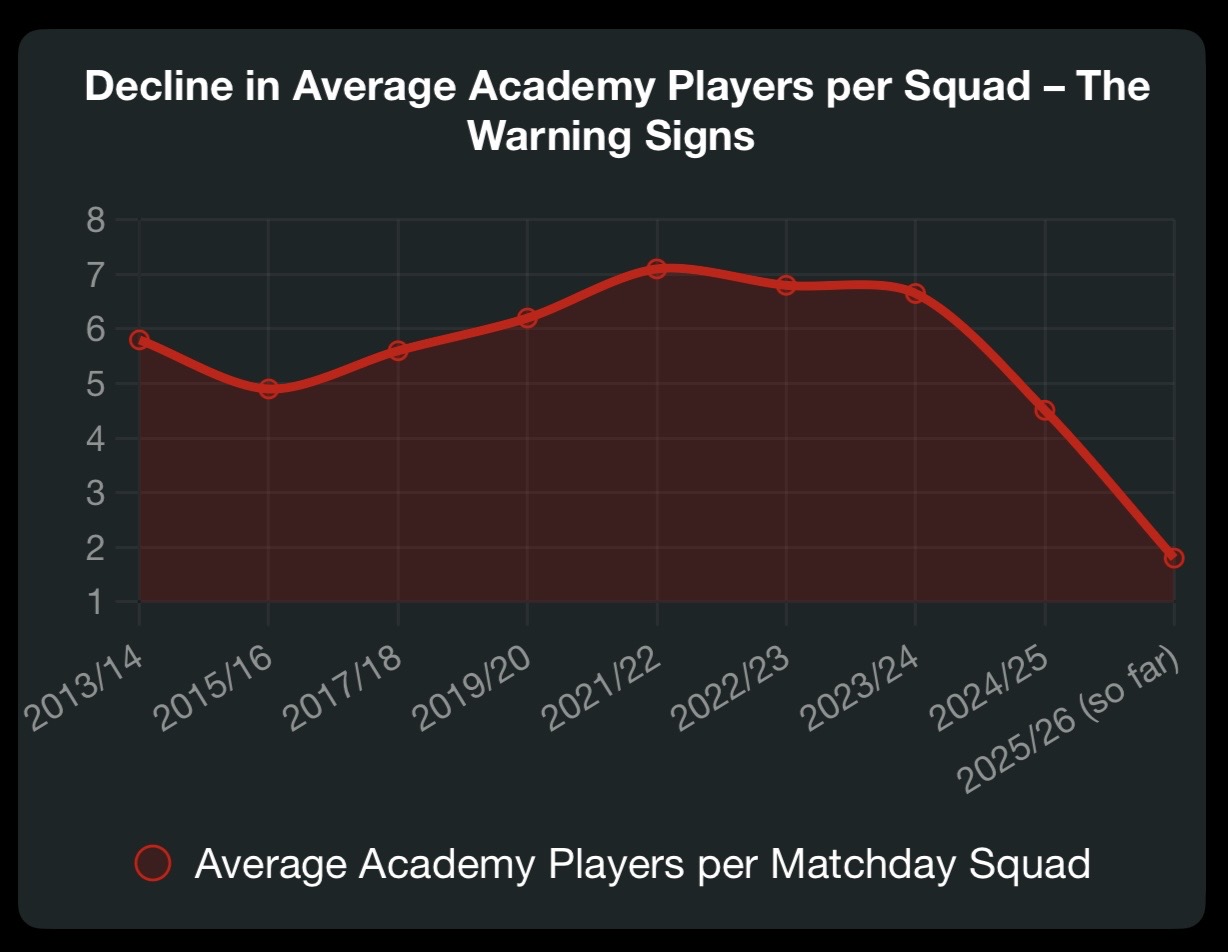
Look at that drop-off. Under Ole and Ralf we were back up near seven. Then something changed. Recruitment became short-term. Loans increased. Pathways narrowed. By the summer of 2025 Rashford was sold to Barcelona, Garnacho fell out with Amorim and moved on, Jonny Evans retired, Amass and Collyer were loaned out. Suddenly Kobbie Mainoo was carrying the torch almost alone.
The 2025 Close Calls – Jack Fletcher Saves the Day
Two weeks ago we played Tottenham. Mainoo picked up a knock. Tom Heaton, our third-choice keeper and the only other eligible academy graduate, wasn’t selected. For the first time since 1937 the streak was genuinely at risk.
Ruben Amorim did what any United manager must do: he turned to the kids. Eighteen-year-old Jack Fletcher – Darren’s lad, signed from City’s academy two years ago but now very much one of ours – was named on the bench. Unused, but there. Record preserved.
Some questioned whether a player who started across town truly counts. Nonsense. Jack has trained at Carrington every day for two years. He’s eaten the canteen food, been screamed at by Travis Binnion, worn the badge in Youth Cup games. He’s ours.
But let’s be honest – and I’ll always be honest, even when it hurts – relying on an 18-year-old making his first ever senior squad just to keep a record alive is not the United way. It’s a symptom of deeper problems. The academy is still producing – Ethan Wheatley, Harry Amass, Jayce Fitzgerald, Louis Jackson, the list is long and exciting – but the first-team pathway has narrowed to a tightrope.
Why This Record Matters More Than Trophies
Trophies come and go. We’ve had lean spells before. But this streak is the proof that Manchester United is not just a brand; it’s a football club with roots that run eight decades deep. Every kid pulling on the red shirt in the U9s at Carrington knows that one day, if they’re good enough, they can sit on the same bench as Giggs, Charlton, Best, Scholes, Mainoo.
When Rashford scored that penalty against PSG, when Garnacho did that overhead kick, when Mainoo slalomed through at Wolves – those moments weren’t bought. They were grown.
The Future – Reasons to Believe
Ruben Amorim has said publicly he wants to “maintain that record, that is for sure.” Good. Because the talent is there. Kobbie Mainoo is already world-class at 20. Ethan Wheatley is banging in goals for the U21s. Shea Lacey is back from injury and looks a generational playmaker. Chido Obi-Martin arrived from Arsenal and is scoring for fun. Bendito Mantato, Jim Thwaites, Godwill Kukonki – the conveyor belt hasn’t stopped; it’s just jammed at the final step.
Fix the pathway, trust the kids again, and we won’t just keep an 88-year record alive – we’ll start a new golden era.
Eighty-eight years.
4,333 games.
One academy.
One love.
This is Manchester United.
And the streak goes on.