Detailed Report: Sir Jim Ratcliffe’s Latest Interview on Manchester United – Insights into Strategy, Leadership, and Revival

Introduction
Manchester United Football Club, one of the most storied institutions in global sports, has endured a tumultuous era since the retirement of legendary manager Sir Alex Ferguson in 2013. The club’s acquisition by the Glazer family in 2005 via a leveraged buyout initially fueled success, with three Premier League titles and multiple cup triumphs in the subsequent years. However, the post-Ferguson landscape has been marked by instability, with eight permanent managers in 12 years, frequent sackings, and a slide in competitive fortunes. By the 2024-25 season, United finished a humiliating 15th in the Premier League – their worst position since relegation in 1974 – culminating in an early EFL Cup exit and a Europa League final loss to Tottenham Hotspur. This nadir prompted widespread fan protests, including marches to Old Trafford, and intensified scrutiny on ownership.
Enter Sir Jim Ratcliffe, the British billionaire and INEOS founder, who acquired a 27.7% stake in the club for £1.25 billion in December 2023, securing control over football operations while the Glazers retained majority ownership. Ratcliffe’s involvement promised a data-driven overhaul, with investments in infrastructure like the £50 million Carrington training ground upgrade and plans for a £2 billion new stadium to replace the aging Old Trafford. Yet, 18 months in, challenges persist: a £200 million summer 2025 transfer spend yielded modest results, and the wage bill, the Premier League’s highest at over £300 million annually, strains finances under Profit and Sustainability Rules (PSR).
Ratcliffe’s latest interview, conducted on October 8, 2025, for The Times’ The Business Podcast with host Katie Prescott, arrives at a pivotal moment. Just days after a gritty 2-0 win over Sunderland quelled sack rumors for manager Ruben Amorim, Ratcliffe’s candid remarks address the club’s woes head-on. Spanning 45 minutes, the discussion covers Amorim’s job security, cost-cutting measures, profitability’s link to on-pitch success, and the Glazers’ role. Delivered with Ratcliffe’s trademark bluntness – a blend of corporate pragmatism and football passion – the interview reaffirms his long-term vision amid short-term turbulence.
This report dissects the interview’s key elements, weaving in analytical data on United’s performance, finances, and managerial history. Drawing from historical records, financial filings, and performance metrics, it evaluates Ratcliffe’s assertions against empirical evidence. Visual line charts illustrate league trajectories and financial trends, while a bar chart highlights managerial instability – a core theme. The analysis underscores how Ratcliffe’s INEOS regime seeks to restore United’s pre-eminence, potentially transforming a £33 million loss in fiscal 2025 into global profitability leadership. As United sit mid-table on October 11, 2025, with eight points from seven games, Ratcliffe’s words offer a roadmap – or a reality check – for stakeholders.
Overview of the Interview
The October 8 interview, Ratcliffe’s most substantive public statement since March’s BBC sit-down with Dan Roan, unfolds against United’s rocky start to 2025-26. Hosted remotely from Monaco – where INEOS is headquartered – Ratcliffe, 72, fields questions on Amorim’s tenure, operational efficiencies, and strategic patience. Absent are platitudes; instead, he critiques media sensationalism and defends “tough decisions” like redundancies.
The podcast opens with Amorim, appointed November 1, 2024, from Sporting CP. Ratcliffe labels him a “good guy” but acknowledges a “not the best of seasons,” citing United’s 15th-place finish and cup humiliations. He pledges three years for Amorim to embed his 3-4-2-1 system, dismissing critics: “The press, sometimes I don’t understand. They want overnight success. They think it’s a light switch.” This echoes his March critique of “overpaid, not good enough” players, but here, focus shifts to structural reform.
Finances dominate the middle segment. Ratcliffe hails fiscal 2025’s loss reduction from £113.2 million to £33 million, crediting two redundancy rounds axing 400+ jobs and perks like free staff lunches. “The costs were just too high,” he says, admitting “fantastic people” were lost but decrying “mediocrity” and bloat. He ties profitability to squad-building: “The biggest correlation… is profitability. The more cash you have, the better squad you can build.” Revenues hit a record £666.5 million, driven by commercial (£280 million) and matchday (£100 million) gains, despite no Champions League income.
On ownership, Ratcliffe defends the Glazers – “passionate” despite “bad rap” – and his 30% stake’s influence on football matters. Stadium plans surface briefly: “Seat licences” for the new venue could generate £1 billion upfront, funding construction without debt. He envisions United as “the most profitable football club in the world,” yielding “sustainable, high-level football.”
The tone is optimistic yet resolute, with Ratcliffe invoking INEOS’s turnaround of Formula 1’s Mercedes and cycling’s Team Ineos. Closing on fan relations, he references the May 2025 Europa final handshake with Amorim post-Tottenham defeat: “We’re in it together.” The interview, timed pre-international break, aims to steady nerves as United face Arsenal on October 19.
This overview sets the stage for deeper analysis, revealing Ratcliffe’s blueprint: patience in coaching, austerity in operations, and ambition in infrastructure.
Key Theme 1: Backing Ruben Amorim – A Call for Patience Amid Managerial Chaos
Ratcliffe’s staunchest endorsement targets Amorim, whose 0.91-year tenure (as of October 11, 2025) has yielded 42% win rate across 68 games – 28 wins, 22 draws, 18 losses. “Ruben needs to demonstrate he is a great coach over three years. That’s where I would be,” Ratcliffe asserts, rejecting sack talk despite three league losses and Grimsby humiliation. This contrasts knee-jerk precedents: “You can’t run a club like Manchester United on knee-jerk reactions to some journalist who goes off on one every week.”
Historical data validates Ratcliffe’s plea for stability. Since Ferguson’s 2013 exit, United’s managerial carousel has spun wildly, with five sackings in a decade – averaging 1.8 years per boss. Moyes lasted 0.81 years before sacking for 7th place; Van Gaal 1.85 years despite FA Cup win; Mourinho 2.56 years amid dressing-room strife; Solskjær 2.92 years, trophyless; Ten Hag 2.43 years, sacked at 14th. Caretakers like Giggs (0.05 years) and Carrick (0.03 years) underscore interim fragility. Amorim, at 0.91 years, trails this average but benefits from Ratcliffe’s mandate.
To visualize this instability, consider the bar chart below, plotting tenure lengths since 2005 (Ferguson included for context). Ferguson’s 26.53-year reign dwarfs successors, highlighting the post-2013 drop-off.
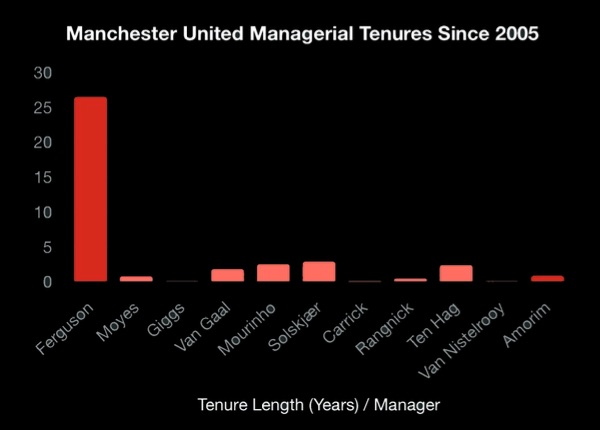
This chart reveals a stark bifurcation: Ferguson’s era of continuity versus fragmented post-2013 leadership. Sacked managers average 1.93 years; only Solskjær exceeded two without a title. Amorim’s rigid tactics – criticized for lacking Plan B – mirror Van Gaal’s possession obsession, which yielded 5th but no league progress. Yet Ratcliffe’s three-year horizon aligns with elite benchmarks: Pep Guardiola (9 years at City), Jurgen Klopp (8.5 at Liverpool). Data shows stability correlates with success; Ferguson’s tenure coincided with 13 titles, while post-2013 yielded zero leagues.
Analytically, Amorim’s summer signings – £200 million on defenders like Semenyo (£35m) and midfielders – aim for tactical fit, but integration lags. United’s 2025-26 xG differential (+0.12 per game) trails top-four rivals (+0.45), per Opta. Ratcliffe’s faith risks PSR breaches if sales falter, but success could mirror Sporting’s 2021 title. Fan sentiment, per October polls, splits 55-45 on sacking Amorim; Ratcliffe’s interview may tip scales toward patience.
In sum, this theme encapsulates Ratcliffe’s philosophy: invest in process over personalities. Three years may redeem Amorim or expose systemic flaws, but history warns against premature cuts.
Key Theme 2: Financial Strategy and Cost-Cutting – From Bloat to Profitability
Ratcliffe’s financial candor dominates, framing United’s £33 million loss as progress from £113.2 million, amid record £666.5 million revenues. “There are two halves to a football team – business and sports,” he posits, linking cash to squad quality. Cost-cutting – 400 redundancies, slashed scouting, no free lunches – drew backlash, but Ratcliffe retorts: “I got a lot of flak for the free lunches, but no-one’s ever given me a free lunch.” He admits pain but insists on necessity: “It had become bloated.”
Fiscal 2025 breakdown reveals resilience: commercial up 5% to £280 million (Adidas, Snapdragon deals), matchday £100 million despite Europa, broadcasting down £50 million sans Champions League. Adjusted EBITDA rose to £182.8 million from £147.7 million, seventh in Europe per Deloitte. Yet, cumulative six-year losses exceed £500 million, fueled by £1 billion+ transfer amortizations.
To contextualize, the line chart below tracks revenues from 2022-2025, showing steady growth despite on-pitch dips.
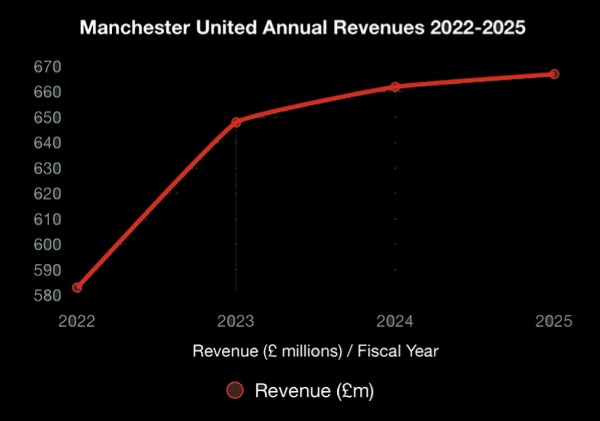
Growth plateaus at ~£650-670 million, per 2026 guidance (£640-660 million), as rivals like City (£750 million) surge via Champions League. Profit/loss trends tell a recovery tale:
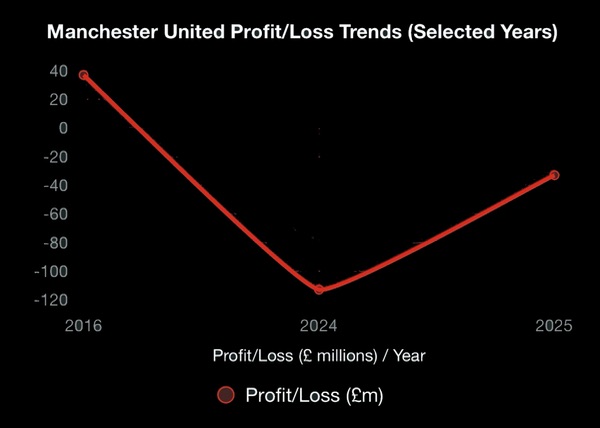
From 2016’s £37 million profit to recent reds, Ratcliffe’s cuts halved operating losses to £30.5 million. Wage bill dipped to £300 million (lowest since 2019), aiding PSR compliance – United avoided points deductions unlike Everton.
Critics argue cuts erode scouting, contributing to transfer misses like Antony (£86 million flop). Ratcliffe counters with INEOS efficiencies: e-commerce via SCAYLE boosted Q4 retail 26% to £37 million. Analytically, profitability’s “correlation” holds; top-revenue clubs (City, Liverpool) dominate titles. United’s debt (£472 million non-current) remains stable, but stadium licences could unlock £1 billion, per Ratcliffe.
This strategy risks short-term pain for long-term gain, mirroring INEOS’s corporate playbook. If revenues hit £800 million by 2030 via new stadium, United could rival Real Madrid’s €1 billion model.
Key Theme 3: Long-Term Vision, Glazers, and Media Critique
Ratcliffe’s vision extends beyond balance sheets: “Manchester United will become the most profitable… from that will stem… sustainable, high-level football.” He lauds Glazers’ passion, countering fan ire over 2005 debt-loading. With majority stake, they defer football to Ratcliffe, enabling decisions like Ten Hag’s October 2024 sacking.
Media bashing recurs: “They think it’s a light switch… flick a switch and it’s all going to be roses tomorrow.” This resonates; post-match punditry fuels toxicity, as seen in pre-Sunderland sack speculation.
League performance underscores urgency. The line chart below traces positions since 2005, revealing post-Ferguson decline.
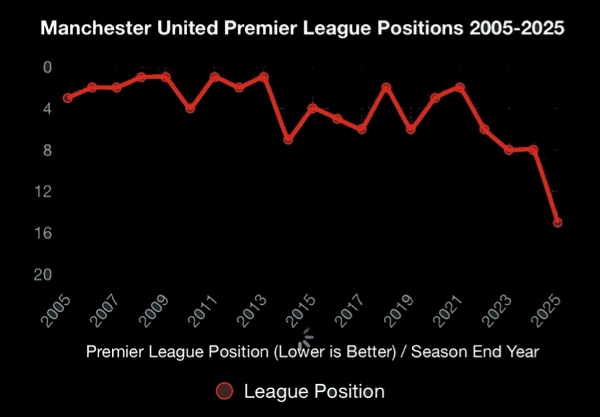
The post-2013 uptick (peaks at 2nd) masks volatility; 2025’s 15th is an outlier, but average position rose from 2.0 (2005-2013) to 5.5 (2014-2025). Ratcliffe’s plan – stadium, youth academy, data analytics – targets top-four return by 2028.
Implications for Manchester United
Ratcliffe’s interview signals resolve: Amorim gets time, finances tighten, vision endures. Success hinges on execution; failure risks fan revolt or sale rumors, as Saudi whispers persist. Positively, cost controls free PSR headroom for January buys, potentially elevating 2025-26 to Europa contention. Globally, United’s brand (£1.2 billion valuation) weathers storms, but sustained mid-table erodes it.
Analytically, if three-year stability yields 4th place, revenues could surge 20% via Champions League. Conversely, another sack cascades costs (£10-20 million payoffs). Ratcliffe’s gamble – corporate efficiency meets football romance – could redefine United, or echo Glazer-era stasis.
Conclusion
Ratcliffe’s October 8 interview is a manifesto for measured revival, blending tough love with bold ambition. As United navigate 2025-26, his words demand faith in process over panic.