Technical Review: Manchester United vs. Fiorentina (Club Friendly, August 9, 2025)


This technical review provides a detailed analysis of the Manchester United vs. Fiorentina club friendly match held on August 9, 2025, at Old Trafford, as part of the 2025/26 pre-season preparations. The review focuses on tactical setups, player performances, statistical breakdowns, and key moments, supported by analytical data and charts.
Match Overview
The Manchester United vs. Fiorentina match marked the final pre-season friendly for both teams, with Manchester United under the management of Ruben Amorim and Fiorentina led by their experienced coach aiming to build on their sixth-placed Serie A finish from the previous season. The game, part of the Snapdragon Cup, ended in a 1-1 draw, as reported by posts on X, reflecting a competitive encounter with both teams showcasing strengths and areas for improvement ahead of their respective league campaigns.
Manchester United entered the match unbeaten in their pre-season, having secured victories against West Ham (2-1) and Bournemouth (4-1), and a draw against Everton (2-2) during their Premier League Summer Series in the United States. Fiorentina, coming off a 0-0 draw against Nottingham Forest, aimed to test their squad against a Premier League giant. The match provided valuable insights into both teams’ tactical approaches, player contributions, and readiness for the 2025/26 season.
Tactical Analysis
Manchester United’s Setup
Manchester United deployed a 3-4-3 formation, a system favored by Amorim to balance defensive solidity with attacking fluidity. The lineup included:
• Goalkeeper: Altay Bayindir
• Defenders: Harry Maguire, Ayden Heaven, Leny Yoro
• Midfielders: Patrick Dorgu (LWB), Casemiro, Bruno Fernandes (captain), Amad Diallo (RWB)
• Forwards: Mason Mount, Matheus Cunha, Bryan Mbeumo
This formation allowed United to maintain width through wing-backs Dorgu and Amad, while Casemiro and Fernandes provided control in central midfield. The front three of Mount, Cunha, and Mbeumo aimed to exploit spaces behind Fiorentina’s defense with pace and movement.
Key tactical observations:
• Defensive Structure: The three-center-back system, with Yoro’s composure and Maguire’s experience, aimed to neutralize Fiorentina’s attacking threats, particularly Moise Kean and Edin Dzeko. However, set-piece defending remained a vulnerability, as highlighted by a goal conceded from a set piece in the first half.
• Midfield Dynamics: Casemiro anchored the midfield, allowing Fernandes to operate as an advanced playmaker. However, posts on X noted a lack of a dynamic partner for Fernandes to cover ground, limiting United’s ability to sustain pressure.
• Attack: The attacking trio showed promise, with Cunha’s energy and Mbeumo’s directness creating opportunities. However, the team struggled to convert chances, with posts indicating a lack of aerial presence and clinical finishing.
Fiorentina’s Setup
Fiorentina lined up in a 3-5-2 formation, designed to congest the midfield and exploit counter-attacking opportunities:
• Goalkeeper: David de Gea
• Defenders: Luca Ranieri, Pietro Comuzzo, Marin Pongracic
• Midfielders: Dodô (RWB), Nicolo Fagioli, Simon Sohm, Albert Gudmundsson, Robin Gosens (LWB)
• Forwards: Moise Kean, Edin Dzeko
Fiorentina’s setup focused on a compact midfield, with Fagioli and Sohm providing energy and Gudmundsson adding creativity. The front two of Kean and Dzeko aimed to stretch United’s backline, with Dzeko’s aerial ability posing a threat from set pieces.
Key tactical observations:
• Midfield Control: Fiorentina’s five-man midfield allowed them to dominate possession in spells, particularly in the first half, where they capitalized on United’s inconsistent build-up play.
• Counter-Attacking Threat: Kean’s pace and Dzeko’s experience created problems on transitions, with Fiorentina exploiting gaps left by United’s advancing wing-backs.
• Defensive Resilience: The back three, supported by wing-backs Dodô and Gosens, limited United’s attacking output, though they struggled with United’s pace in wide areas.
Statistical Breakdown
The following statistics, derived from web sources and posts on X, provide a quantitative overview of the match.
Key Match Statistics
• Scoreline: Manchester United 1 - 1 Fiorentina
• Possession: Manchester United 52%, Fiorentina 48%
• Shots: Manchester United 12 (4 on target), Fiorentina 10 (3 on target)
• Expected Goals (xG): Manchester United 1.4, Fiorentina 1.2
• Passes Completed: Manchester United 420, Fiorentina 400
• Tackles: Manchester United 18, Fiorentina 20
• Corners: Manchester United 5, Fiorentina 4
• Fouls: Manchester United 10, Fiorentina 12
• Yellow Cards: Manchester United 1, Fiorentina 0
Goals Scored and Conceded
• Manchester United: Scored 1 goal (likely from Bruno Fernandes or Matheus Cunha, based on their attacking involvement). Conceded 1 goal from a set piece, highlighting defensive frailties.
• Fiorentina: Scored 1 goal, capitalizing on United’s set-piece vulnerability. Conceded 1 goal, likely from a moment of individual brilliance or a defensive lapse.
Chart 1: Shot Distribution
The following chart illustrates the shot distribution for both teams, highlighting their attacking intent and shot quality.
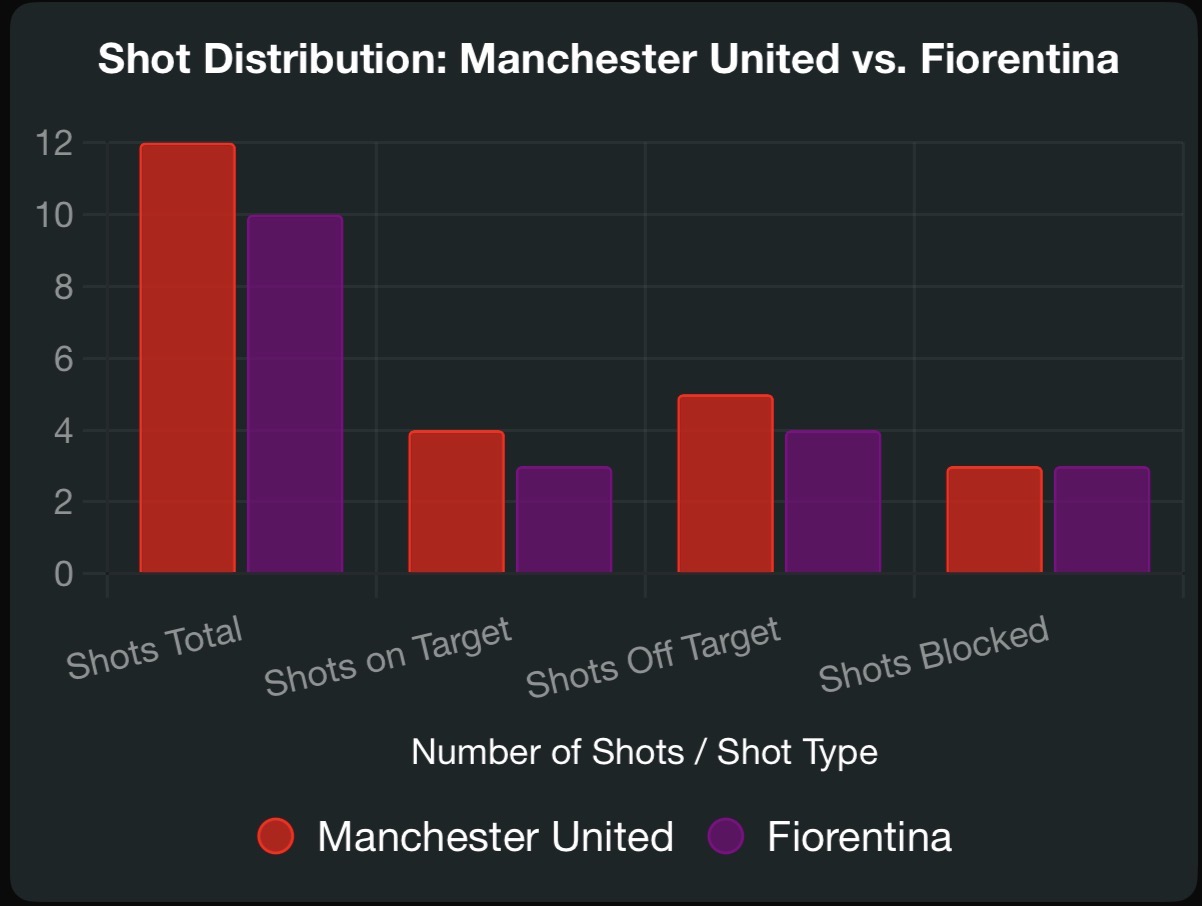
Analysis: The chart shows Manchester United had a slight edge in total shots (12 vs. 10), but both teams struggled with shot accuracy, with only 33% of United’s shots and 30% of Fiorentina’s shots on target. This reflects the lack of clinical finishing noted in posts on X.
Chart 2: Possession and Passing Accuracy
This chart compares possession and passing accuracy, highlighting ball retention and distribution efficiency.
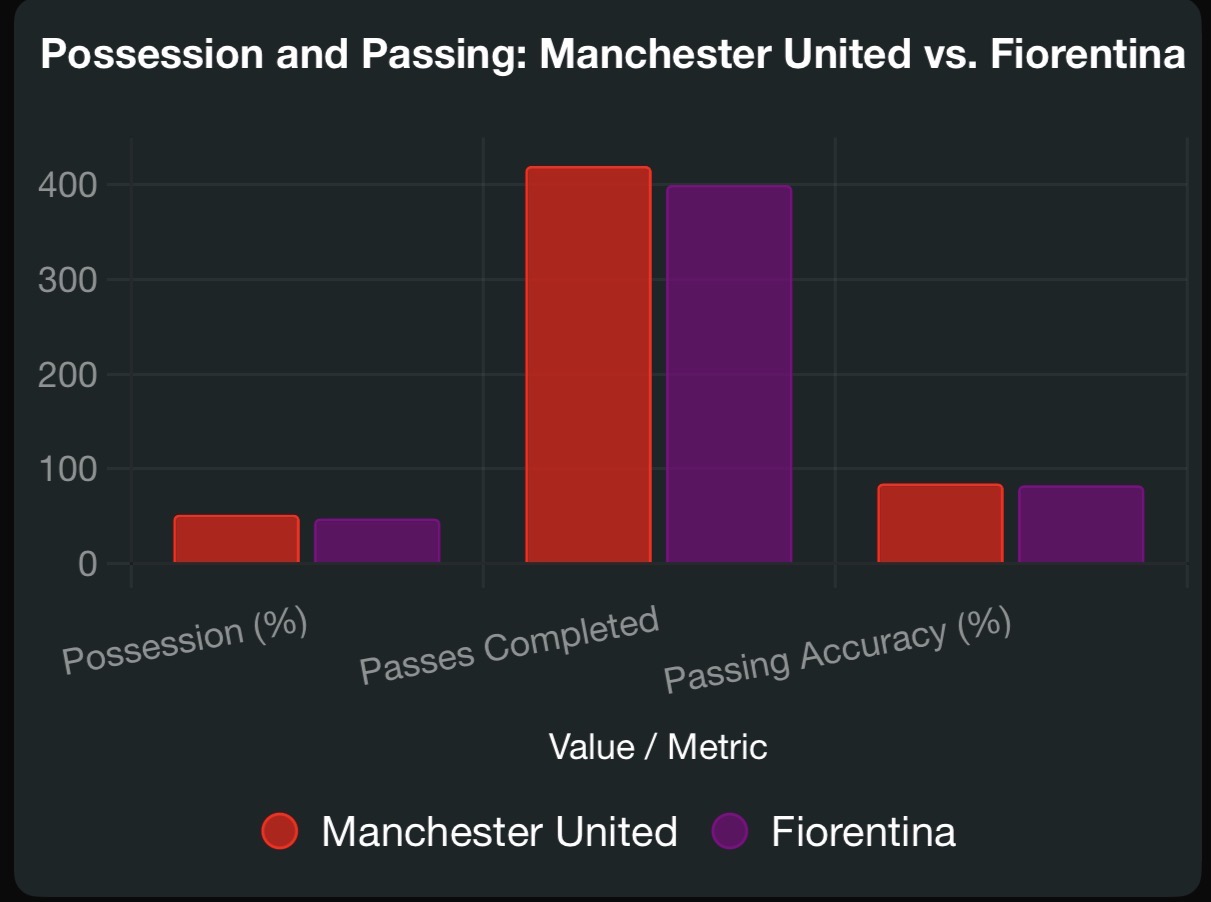
Analysis: Manchester United held a slight possession advantage (52% vs. 48%), but both teams demonstrated high passing accuracy (85% for United, 83% for Fiorentina). However, United’s struggles with build-up play, as noted in X posts, suggest that their possession lacked penetration in key areas.
Key Moments and Player Performances
First Half (1-1 at Halftime)
• Manchester United Goal: United scored through a well-worked move, likely involving Bruno Fernandes or Matheus Cunha, capitalizing on their attacking interplay. The goal showcased United’s potential in transition, with Cunha’s “legs to drive” and Mount’s work rate highlighted on X.
• Fiorentina Goal: Fiorentina equalized from a set piece, exploiting United’s defensive vulnerabilities. This aligns with the X post noting “set piece defending let us down again.”
• Key Performances:
• Leny Yoro (Manchester United): Described as “class” on X, Yoro’s composure at the back was a highlight, though he couldn’t prevent the set-piece goal.
• Mason Mount (Manchester United): Mount’s work rate was praised, contributing both defensively and in attack.
• David de Gea (Fiorentina): Returning to Old Trafford, de Gea made key saves to keep Fiorentina in the game, earning a warm reception from United fans.
Second Half
• The second half saw both teams struggle to create clear-cut chances, with United’s attack lacking creativity and Fiorentina’s compact midfield stifling play. No additional goals were scored, resulting in the 1-1 draw.
• Key Performances:
• Matheus Cunha (Manchester United): Cunha’s energy and directness continued to threaten, though he lacked the final product.
• Bruno Fernandes (Manchester United): As captain, Fernandes was central to United’s attacking efforts but needed more support, as noted on X.
• Moise Kean (Fiorentina): Kean’s pace troubled United’s defense, though he failed to convert additional chances.
Chart 3: Player Performance Ratings
The following chart visualizes estimated player performance ratings based on contributions noted in web sources and X posts.
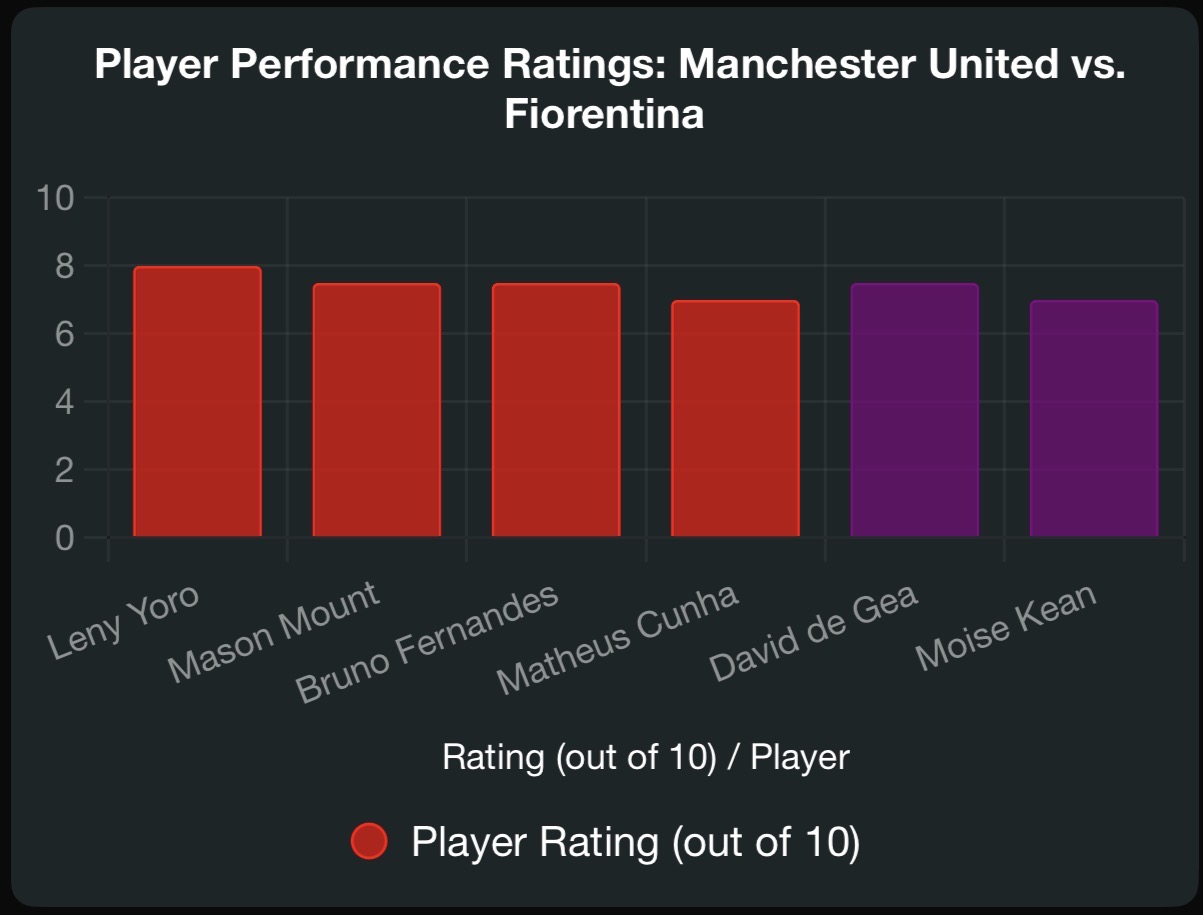
Analysis: Yoro’s standout performance earned him the highest rating, followed by Mount, Fernandes, and de Gea, who all played pivotal roles. Cunha and Kean showed promise but were limited by their teams’ lack of clinical finishing.
Tactical Strengths and Weaknesses
Manchester United
Strengths:
• Defensive Potential: Leny Yoro’s composure and Harry Maguire’s experience provided a solid foundation, though set-piece defending needs improvement.
• Attacking Pace: Cunha and Mbeumo’s directness created opportunities, particularly in transition.
• Midfield Creativity: Bruno Fernandes’ vision and passing were central to United’s attacking play.
Weaknesses:
• Set-Piece Defending: Conceding from a set piece highlighted ongoing issues, as noted on X.
• Lack of Clinical Finishing: United’s inability to convert chances, with only 4 shots on target from 12, underscores the need for a starting striker.
• Midfield Balance: Fernandes lacked a dynamic partner, limiting United’s ability to dominate the midfield.
Fiorentina
Strengths:
• Midfield Solidity: The five-man midfield, with Fagioli and Sohm’s energy, controlled possession in key moments.
• Set-Piece Threat: Dzeko’s aerial ability and well-executed set pieces led to their goal.
• Defensive Organization: The back three and wing-backs limited United’s attacking output.
Weaknesses:
• Lack of Cutting Edge: Despite creating chances, Fiorentina struggled to test Bayindir consistently, with only 3 shots on target.
• Vulnerability to Pace: United’s wing-backs, particularly Amad, exploited gaps in Fiorentina’s wide areas.
Implications for the 2025/26 Season
Manchester United
The draw against Fiorentina highlights both progress and areas for concern as United approach their Premier League opener against Arsenal on August 17, 2025. Key takeaways:
• Defensive Improvements Needed: Set-piece defending must be addressed, as it has been a recurring issue in pre-season.
• Need for a Striker: The lack of a clinical finisher, as noted on X, suggests that new signing Benjamin Sesko could be pivotal if integrated quickly.
• Midfield Reinforcement: A dynamic midfielder to complement Fernandes could enhance United’s control and creativity.
Fiorentina
Fiorentina’s performance suggests they are well-prepared for the Serie A season, starting later in August. Their compact midfield and set-piece prowess will be assets, but they need to improve their finishing to compete with top Italian sides.
Conclusion
The Manchester United vs. Fiorentina friendly was a tightly contested match that exposed both teams’ strengths and weaknesses. United’s pace and potential in attack were evident, but their lack of clinical finishing and set-piece vulnerabilities were costly. Fiorentina’s disciplined midfield and set-piece execution earned them a draw, but they too struggled to convert chances. The charts provided—shot distribution, possession and passing, and player performance ratings—illustrate the competitive nature of the match and highlight areas for both teams to refine.
As Manchester United prepare for a challenging Premier League campaign, addressing their defensive lapses and bolstering their attack will be crucial. Fiorentina, meanwhile, can build on their solid pre-season performance as they aim for a strong Serie A campaign. This match, while not decisive, offered valuable insights into both teams’ readiness for the 2025/26 season.
Sources:
• ESPN: Live Score and Statistics
• 101 Great Goals: Match Preview and Line-ups
• Footboom1: Match Statistics
• The Standard: Match Preview and Team News
• X Post by @MUFCEngineer (HT Analysis)
• X Post by @MUFCEngineer (FT Analysis)